Digital PR Guide: Strategy, Cost, Examples, and AI Search Visibility
Digital PR gets thrown around a lot lately, and half the time it’s used as a fancier word for “we got you a backlink.” I get why. But if you’ve ever pitched a journalist, landed a mention, and watched it do more for your brand than a dozen guest posts combined, you already know it’s something else entirely.
I’ve run campaigns where the coverage barely moved the needle on links but completely changed how a client’s name showed up in conversations, in AI-generated answers, in “who should I talk to about this” recommendations. That’s the part most explanations skip. Digital PR isn’t a link-building tactic wearing a PR costume — it’s PR, doing what PR has always done, just built for a search-driven world.
What Is Digital PR?
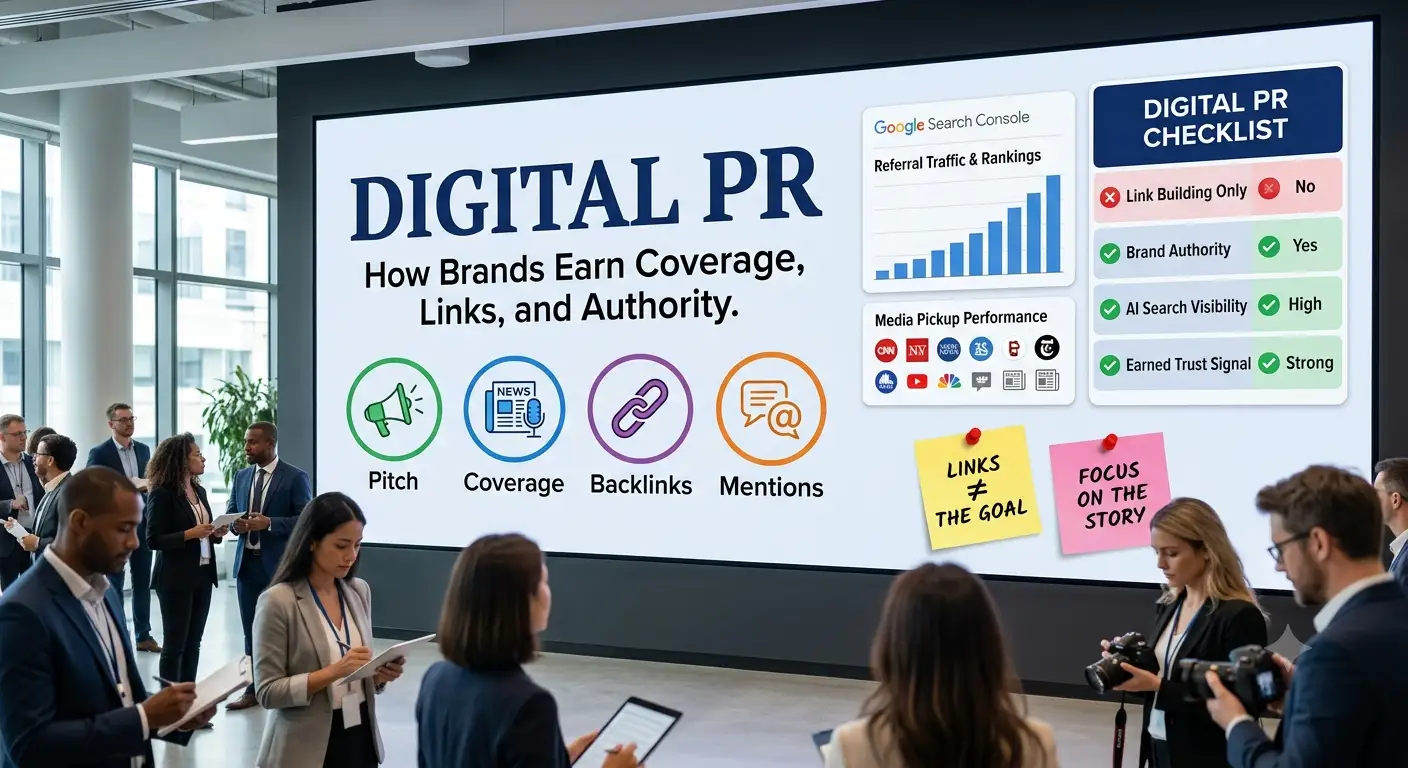
Digital PR is the practice of earning media coverage, mentions, and backlinks by getting your brand, story, or data in front of journalists, bloggers, and publishers online. Think of it as traditional PR’s answer to the internet: instead of chasing a mention in the evening paper, you’re chasing a mention on a site Google (and now AI search) actually trusts.
Here’s how I explain it to clients who’ve never heard the term before: if you’ve ever pitched a story, sent original research to a reporter, or gotten quoted in an industry roundup, you’ve already done digital PR — you just didn’t call it that.
At its core, digital PR usually revolves around a few repeatable moves:
- Creating something worth covering
Original data, a survey, a bold take, a tool, a study — something a journalist can’t just make up themselves. - Getting it in front of the right people
Journalists, niche bloggers, industry newsletters, podcast hosts — whoever’s audience overlaps with yours. - Earning the write-up
Not paying for it, not guest-posting your way into it. Earning it because the story’s genuinely useful to their readers. - Capturing the value
That usually means a backlink, but increasingly it also means a brand mention, a quote, or just visibility in places your audience already trusts.
That last point matters more than most people realize. I’ve had campaigns land great coverage with zero dofollow links attached, and they still moved the needle — because Google (and large language models pulling in web data) pay attention to brand mentions even without a link. Digital PR isn’t just chasing links anymore. It’s chasing relevance.
One thing I always tell people new to this: digital PR isn’t a single tactic, it’s a category. HARO-style pitching, data journalism, newsjacking, expert commentary — they all fall under it.
Digital PR vs Traditional PR vs Link Building
This is the section that trips people up the most, and honestly, I get why. All three terms get used interchangeably in briefs, in agency pitches, even in job titles — “PR Manager,” “Link Building Specialist,” “Digital PR Executive” — like they’re just different flavors of the same job. They’re not.
Each one starts from a different question, chases a different outcome, and gets measured differently, and mixing them up is exactly how campaigns end up with the wrong strategy attached to the wrong goal. So let’s untangle it properly, one comparison at a time.
Digital PR vs. Traditional PR
Traditional PR and digital PR are the same discipline at heart — you’re managing how a brand is perceived and talked about. The difference is where that conversation happens and how you measure whether it worked.
Traditional PR lives in print, broadcast, and offline events. Success looks like a mention in the newspaper, a segment on the local news, a quote in a trade magazine. It’s hard to trace that mention back to a business outcome. Digital PR lives online — and because it lives online, everything is trackable. You can see the referral traffic, the backlink, the ranking movement, the brand search volume spike after a big feature goes live.
I’ve worked with clients who came from a traditional PR background, and the adjustment is always the same: they’re used to measuring success by “we got covered.” Digital PR asks a harder question — “did that coverage actually do anything?”
Digital PR vs. Link Building
This is the mix-up I run into constantly. People hear “digital PR” and assume it just means “link building, but fancier.” It’s not — and treating it that way is how campaigns end up feeling hollow.
Link building is often transactional. You’re reaching out specifically because you want a link, and the content or pitch exists to justify that ask. Digital PR flips the order: you create something genuinely newsworthy first, then links happen as a byproduct of people covering it because it’s actually useful, surprising, or relevant to their audience.
Here’s the distinction I give clients when they ask me to “just build backlinks” and I steer them toward digital PR instead: a link builder asks “who can I get a link from?” A digital PR practitioner asks “who would care about this story, with or without a link?”
That mindset shift changes the entire campaign — what you create, who you pitch, and what you’re willing to walk away from. And it’s exactly why digital PR tends to outperform link building long-term: it earns brand visibility and mentions even when a link doesn’t happen to come with it.
Why Is Digital PR Important?
I’ll be honest — a few years ago I could’ve answered this with one word: links. Digital PR earned links that were harder (and safer) to get than most outreach tactics, and that alone justified the budget. But if that’s still the only reason you’re considering it, you’re underselling what it actually does.
The brands winning right now are using digital PR to shape how they show up everywhere — search results, AI-generated answers, industry conversations, even in front of people who’ll never click through to their site at all. Here’s what that actually looks like broken down.
- It builds authority Google can’t ignore
Coverage from sites Google already trusts — news outlets, industry publications, established blogs — signals that real, credible sources vouch for you. That’s harder to fake than a link from a random guest post, and Google knows it. - It shapes how AI search describes you
This is the part most people are sleeping on. When someone asks ChatGPT or Google’s AI Overview “who’s good at X,” those answers are pulled from what’s been written about you across the web — mentions, quotes, coverage. If nobody’s talking about your brand anywhere credible, you’re invisible to that conversation, link or no link. - It drives real traffic, not just rankings
A feature on a site your audience actually reads sends people straight to you — no SERP required. I’ve had single placements outperform months of blog traffic. - It builds brand trust faster than content marketing alone
Being featured by a third party carries more weight than saying it about yourself. Readers trust “here’s what Forbes said about them” more than “here’s what we say about ourselves.” - It compounds
Unlike a paid placement that disappears the moment the budget stops, earned coverage tends to stick around — indexed, cited, sometimes picked up by other publications who saw it first.
Digital PR isn’t just an SEO tactic anymore. It’s become the layer that determines whether you’re part of the conversation at all — in search, in AI, and in your industry.
Also Read: Off-Page SEO: The Complete Guide to Ranking Beyond Your Website
Digital PR Strategies and Tactics
This is where digital PR stops being a concept and turns into an actual to-do list. Over the years I’ve run (and sometimes abandoned) most of the tactics under this umbrella, and the honest truth is none of them work in isolation — the strongest campaigns usually stack two or three together. Here’s the breakdown of what’s actually worth your time, and where each one tends to pay off.
Data-driven campaigns
This is the backbone of most modern digital PR. You run a survey, analyze a dataset, or pull numbers nobody’s published before, then package it into something a journalist can build a story around. I’ve seen a single well-timed data campaign — something as simple as “we surveyed 500 people about X” — outperform six months of guest posting, purely because it gave reporters something concrete to cite.
HARO and journalist request platforms
Reporters are constantly looking for expert quotes on deadline, and platforms like HARO (now Connectively), Qwoted, and Featured connect you to those requests. It’s low-cost, but it’s also a volume game — you’re pitching dozens of requests to land a handful of usable quotes. I tell clients not to expect instant wins here; it’s a long-game tactic that compounds.
Newsjacking
Attaching your brand’s expertise to a trending story while it’s still relevant. Done well, it’s fast and can land serious coverage. Done badly — forcing a connection that isn’t really there — it reads as opportunistic and can backfire. The rule I follow: if I have to explain the connection in more than one sentence, it’s too much of a stretch.
Expert commentary and thought leadership
Positioning yourself (or a spokesperson) as the go-to quote for a specific topic. This overlaps with HARO-style pitching but goes further — building a relationship with specific journalists or publications so they come back to you directly instead of you chasing every request.
Digital PR stunts and campaigns
Bigger, more creative pieces built specifically to be newsworthy — interactive tools, quizzes, unusual research angles, campaigns tied to a cultural moment. These take more budget and planning but tend to earn the most links and the widest coverage when they land.
Resource and mention reclamation
The quieter tactic nobody talks about enough: finding places your brand’s already been mentioned without a link, or where a broken/outdated resource could be replaced with yours, and reaching out to fix it. Lower effort, decent conversion rate, and it’s usually the first thing I check before starting a bigger campaign.
Don’t pick one tactic and expect it to carry the whole strategy. Most of my best-performing campaigns pair a data-driven asset with expert commentary — the data gets the pitch opened, and the expert quote is what makes it usable.
How to Create a Digital PR Campaign
This is the part people always ask me to skip straight to — “just tell me the steps.” Fair enough. But I’ll say this upfront — the campaigns that flop almost always skipped step one and jumped straight to pitching. So bear with the order here, it matters more than it looks.
1. Start with an angle, not a link
Before anything else, ask yourself what’s actually newsworthy here. Not “what can I create to get a link,” but “what would a journalist genuinely want to write about, with or without us in the story.” If you can’t answer that honestly, the campaign isn’t ready yet.
2. Validate the angle with real data or a real hook
Once you’ve got an angle, back it up. That could be original research, a survey, an analysis of existing public data, or genuine expert insight nobody else is offering. I always sanity-check this stage by asking whether this story would stand up even if my brand’s name wasn’t attached to it. If yes, it’s strong enough to pitch.
3. Build the asset
Turn the angle into something a journalist can actually use — a report, a data visualization, a quote-ready summary, a landing page with the full findings. This is also where you prep the shareable version, including a press release, key stats pulled out, and maybe a chart or two journalists can lift directly.
4. Build your media list
Don’t blast a generic pitch to 200 random journalists. I keep lists segmented by beat and past coverage — someone who’s written about your exact topic in the last six months is worth ten cold contacts who haven’t. Tools like Prowly or a manually built spreadsheet both work; what matters is relevance, not volume.
5. Pitch with the story, not the sell
Lead with what’s interesting to their readers, not what’s good for your brand. The best pitches I’ve sent read almost like a mini press release, with a headline-worthy line up top, a key stat second, and an offer for more data or an interview third. If a journalist has to dig to find the story, you’ve already lost them.
6. Follow up (once, maybe twice)
Journalists get flooded. One thoughtful follow-up a few days later is fine. More than that starts working against you — I’ve had journalists tell me flat out that repeated follow-ups are the fastest way to get blacklisted from future pitches.
7. Track what happens next
Once coverage starts coming in, log it — the outlet, the link if there is one, the mention, the date. You’ll need this for measurement later, and it’s also useful leverage for your next pitch, since “we were recently featured in X” opens doors.
8. Repurpose the coverage
Don’t let a placement just sit there. Mention it on your site, in your newsletter, on social. Coverage earns more coverage — journalists notice when other outlets have already picked something up, and it makes your next pitch easier to say yes to.
The pattern across all of this is that campaigns that work are built backwards from “would this stand on its own as a story,” not forwards from “what can we get a link out of.”
Also Read: Do Social Signals Actually Impact Your SEO in 2026?
How Much Does Digital PR Cost?
This is usually the question clients ask right after “how does it work,” and honestly, it’s fair — digital PR isn’t cheap, and anyone telling you otherwise is either underselling the effort or overselling the results. Let’s talk real numbers.
What the market actually pays
Most digital PR programs land between $3,000 and $10,000 a month, with the market-average digital PR retainer sitting around $5,458, and half of all programs coming in under $5,000. Agencies tend to charge roughly 50% more than freelancers do, averaging around $6,357 a month against $4,200 for freelance support. I’ve found this tracks with what I see in the field — the “$5K a month” range is the realistic starting point for most brands, not the $500 packages some freelancers advertise to get in the door.
Freelancer or in-house specialist
If you’re hiring someone to run campaigns part-time or handling it yourself with a paid tool stack, freelance support tends to land closer to the lower end of that market average, mostly going toward tools, journalist database access, and time. This works fine for smaller brands doing steady, low-key campaigns rather than big swings.
Agency retainers
Agency retainers sit higher, both because of overhead and because you’re often paying for existing journalist relationships that take years to build. The wider the outreach and the more competitive the target publications, the more that retainer climbs.
Per-link and per-campaign economics
If you’re comparing this against a straight link-building quote, it helps to look at the per-link cost breakdown for digital PR campaigns, which typically runs from around $375 to $1,500 or more depending on how it’s purchased — averaging roughly $600 to $750 for managed campaigns, and running $1,250 to $1,500 for one-off standalone link placements. That price per link looks steep until you factor in that you’re also getting brand visibility and mentions that link-building alone never delivers.
What actually drives the cost up
A few things push the price higher every time. Original research and data collection take real time and sometimes paid survey tools. Design and development for interactive assets add production cost. Journalist outreach tools like Prowly, Cision, or Muck Rack come with real subscription fees. And frankly, experience matters here — a practitioner with existing journalist relationships will usually land better coverage faster than someone cold-pitching from scratch, and that expertise costs more for good reason.
My honest take for anyone weighing this decision is that digital PR isn’t a good fit for a one-off, tiny budget play. It rewards consistency. A single campaign might land you one great placement, but the compounding value comes from doing this regularly enough that journalists start recognizing your name before you even pitch them.
How Do Digital PR and SEO Work Together?
I get asked this a lot by clients who’ve been running SEO for years but never touched digital PR, and my answer is always the same. If you’re doing SEO without digital PR, you’re optimizing a house nobody’s heard of. Digital PR is what gets people talking about the house in the first place.
Digital PR feeds your backlink profile
This is the obvious connection, but it’s worth saying plainly. Links earned through digital PR tend to come from higher-authority, more relevant sites than the average outreach link, and Google treats those differently. I’ve seen a single feature on a well-known industry site do more for a domain’s authority than fifty low-quality guest post links combined.
It builds topical authority around your brand
When multiple credible sites mention you in the context of a specific topic, Google starts associating your brand with that topic, even beyond the pages that link directly to you. This matters more now that search results increasingly reward entities Google recognizes as established, not just pages that rank well individually.
It drives branded search, and branded search is a ranking signal
Here’s something I don’t think gets talked about enough. When coverage lands, people search your brand name afterward, sometimes alongside the topic you were covered for. That branded search volume is a trust signal Google picks up on, and it’s one link building alone almost never produces, since nobody Googles a brand they found through a random guest post.
It’s become essential for AI search visibility
This is the part that’s changed the game recently. Large language models and AI Overviews pull their answers from what’s already been written about a brand across the web, not just from your own site. If your only online presence is your own content, you’re invisible to that layer entirely. Coverage from third-party sites is what tells an AI model “this brand is worth mentioning” when someone asks a related question.
SEO tells digital PR where to aim
This works both directions. Good keyword research and content strategy show you which topics your audience actually cares about, and that’s exactly where your digital PR angles should come from. I always start a campaign by checking what’s already ranking and what gaps exist, so the story I’m pitching lines up with a topic that has real search demand behind it.
The honest summary here is that SEO without digital PR gets you found. Digital PR without SEO gets you talked about but not necessarily discovered. Run them together, and each one makes the other work harder.
How to Measure Digital PR Success
This is the section I wish more people asked about before running a campaign, not after. Too many brands launch a digital PR push, get a handful of placements, feel good about it, and never actually check whether it moved anything that matters.
The truth is no single metric tells the whole story here, since links, traffic, mentions, and rankings all capture a different piece of what a campaign actually did. What I usually do with clients is track a handful of these together and read them as a set, rather than fixating on one number and calling it a win or a loss. Here’s what actually matters and why.
- Links earned and link quality
Start with the obvious metric, but go beyond just counting them. I look at the authority of the sites linking back, whether the link is dofollow or nofollow, and whether it’s placed in a relevant, contextual part of the article rather than buried in a footer or sidebar. Ten links from sites your audience actually reads beat fifty links from random directories every time. - Referral traffic
Check your analytics for traffic coming directly from the sites that covered you. This tells you something links alone never will, since it shows whether real people actually clicked through and landed on your site. I’ve had campaigns with modest link counts drive genuinely strong referral traffic because the placement was on a site with an engaged, relevant readership. - Brand mentions, linked and unlinked
Set up tracking for your brand name showing up anywhere online, not just where it’s linked. Tools like Google Alerts, Talkwalker, or Brand24 catch this. Unlinked mentions still matter for the reasons we covered earlier, since they build the entity signals Google and AI models pick up on even without a direct link. - Branded search volume
Watch your branded search terms in Google Search Console before and after a campaign launches. A spike here is one of the clearest signs that coverage actually reached people and made them curious enough to look you up directly. - Keyword rankings and organic traffic
Track how the pages tied to your campaign move in rankings over the following weeks and months. Digital PR rarely produces instant ranking jumps, so give it time, usually a few months, before judging whether it worked. - Domain authority movement
This one’s a lagging indicator, but worth tracking over a longer window, quarterly rather than monthly. A steady, consistent digital PR effort should show gradual authority growth over time, even if any single campaign doesn’t move it much on its own. - Share of voice
For bigger brands running ongoing campaigns, it’s worth tracking how often you show up in coverage compared to competitors on the same topics. This is harder to measure precisely, but even a rough manual tally of “who’s getting covered for this subject” tells you where you stand.
My honest advice here is to pick two or three of these that map to your actual business goals instead of trying to track everything. A B2B brand chasing enterprise leads cares more about relevant referral traffic and share of voice than raw link count. A newer brand still building recognition should watch branded search and mention volume closer than anything else.
Common Digital PR Mistakes to Avoid
I’ve made most of these mistakes myself early on, and I still see them constantly in campaigns I get asked to audit or fix. Some are strategic, some are just execution errors, but they all quietly kill results in ways that are hard to trace back afterward. Here’s what to watch for.
Chasing links instead of chasing the story
This is the root mistake almost everything else stems from. When a campaign starts with “we need links” instead of “what’s actually newsworthy here,” it shows in the pitch, and journalists can tell. I’ve seen brands build an entire asset around a link-building goal, then wonder why nobody covered it. The story has to stand on its own first.
Pitching without reading the publication
Sending the same generic pitch to fifty journalists regardless of their beat is a fast way to get ignored, or worse, blacklisted. I always check what someone’s actually written recently before pitching them. A pitch that references their previous coverage gets read differently than one that’s obviously copy-pasted.
Weak or fabricated data
Nothing kills credibility faster than a journalist digging into your “study” and finding a sample size of twelve people or numbers that don’t hold up. If you’re running original research, do it properly, small sample or not, and be transparent about the methodology when asked. One bad data campaign can damage your relationship with a journalist permanently.
No follow-through after coverage lands
Getting the placement isn’t the finish line. I’ve seen brands earn a great feature and then do nothing with it, no social mention, no newsletter shoutout, no case study, nothing. That coverage should be working for you well after the story goes live.
Ignoring unlinked mentions
Plenty of brands only track links and completely miss mentions without one. Those unlinked mentions still carry value for brand signals and AI visibility, and a simple outreach email asking for the link to be added often works more often than people expect.
Treating digital PR as a one-off project
A single campaign might land a great placement, but digital PR compounds with consistency. Brands that run one campaign, don’t see instant results, and quit are usually the ones who write off digital PR as “not worth it,” when really they just never gave it enough runway to work.
Skipping the relationship-building side
Some people treat every pitch as a cold outreach transaction. The practitioners who get consistently good coverage are the ones journalists already know and trust, because they’ve engaged with their work before ever needing something from them. That takes time, but it pays off every single campaign after the first one.
The pattern across most of these is impatience, either rushing the pitch, rushing the data, or expecting one campaign to prove the whole strategy. Digital PR rewards the people willing to do it properly and consistently, not the people looking for a shortcut.
Digital PR Examples
Theory only goes so far — sometimes the fastest way to understand digital PR is to see what actually landed coverage and why. These two aren’t brand-run campaigns, they’re a different (and honestly more common) digital PR win: getting a business included in a major outlet’s own editorial roundup. It’s less flashy than a viral stunt, but it’s one of the most reliable tactics in the entire discipline.
The New York Times, “The Best Ice Cream Shops in New York City”
This is a classic “best of” roundup published by one of the most trusted mastheads in the world. For any ice cream shop featured in this list, that placement almost certainly didn’t happen by accident.
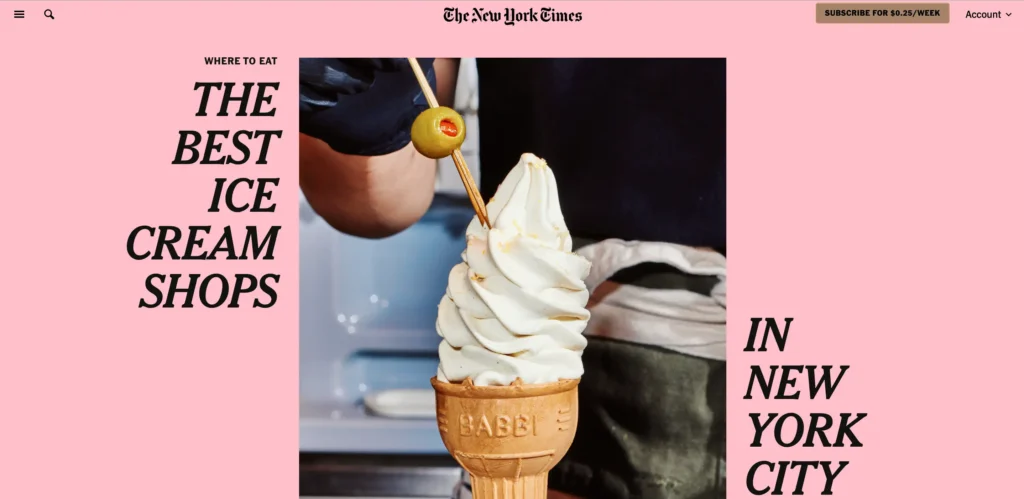
Editors building these guides usually pull from a mix of their own research, reader input, and direct outreach from the businesses themselves, meaning a well-timed pitch, a strong press kit, or an existing relationship with the food desk can be the difference between being in this article or being invisible to it. A single mention here does more for a small business’s credibility than months of paid advertising, purely because it’s the Times saying it, not the business saying it about itself.
Time Out Australia, “The 23 Best Resorts and Lodges in Australia”
Time Out’s editorial team built this roundup from firsthand stays and ongoing coverage of Australia’s luxury travel scene, and it’s a good example of how a curated list compounds in value over time.
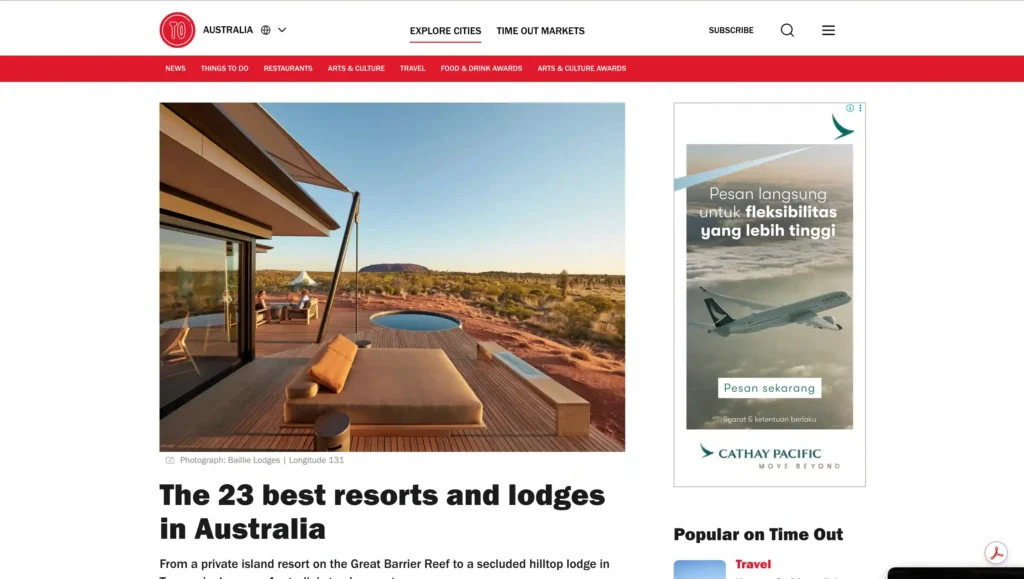
Properties like Southern Ocean Lodge and Lizard Island Resort aren’t just named once, they’re referenced again inside other Time Out articles about Australia’s best hotels and top travel experiences, meaning one successful placement in an editor’s radar can lead to repeat mentions across a publication’s whole content library. That’s the compounding effect we talked about earlier in this article, playing out in real time.
The lesson here is a bit different from our earlier examples. Not every digital PR win comes from a big data study or a viral stunt; sometimes it’s simply about making sure the right editor at the right outlet knows your business exists when they’re building their next “best of” list. That’s a quieter tactic, but for local and hospitality businesses especially, it’s often the highest-value placement you can get.
Future of Digital PR and AI Search
I’ll be straight with you, this section is the one I keep having to rewrite because the ground genuinely shifts every few months right now. But the direction is clear enough that it’s worth building your strategy around it today, not waiting for it to “settle.”
Earned media is now the backbone of AI visibility, not just SEO
Meltwater’s analysis of roughly 5.35 million citations across eight major LLMs found that earned media and news accounted for 39.5% of all citations, and that share has been growing month over month. Separately, Muck Rack’s research on AI citation sources found that 84% of AI citations trace back to earned media rather than brand-owned content, meaning third-party validation is beating self-promotion by a wide margin in AI search.
If your entire online presence is your own website, you’re already behind, since AI models are pulling their answers from what other credible sources say about you far more than from what you say about yourself.
Being included in “best of” listicles matters more than ever
Research on LLM citation building shows 52% of AI citations come from listicles, articles, and product roundups, meaning that if a major publication in your category runs a “Best X of 2026” article and your brand isn’t in it, that’s a direct gap in your AI visibility. This connects straight back to the ice cream shop and resort examples earlier in this article. Getting into an editor’s roundup isn’t just good for traffic anymore, it’s becoming one of the clearest paths into an AI-generated answer.
Unlinked mentions are becoming a real trust signal, not a consolation prize
Recent research on LLM citation building shows that unlinked brand mentions in authoritative industry publications now function as a primary trust signal for AI models, essentially becoming the modern equivalent of link building, where the mention itself carries weight whether or not it links back to your site. I mentioned this earlier when we talked about measurement, but it’s worth repeating here because it changes how you should be pitching. A mention without a link used to feel like a partial win. Now, it might be doing more work than you think.
Citations concentrate around a small number of trusted domains
Fractl’s citation research across multiple studies found that the top 10 domains in a given topic capture 46% of all AI citations, and the top 30 domains own 67%, meaning a relatively small number of publications control most of the visibility within any category. This is why relationship-building with the right journalists and publications, the thing we talked about back in the mistakes section, matters more now than it did five years ago. It’s not about getting mentioned anywhere, it’s about getting mentioned in the handful of sources a given AI model already trusts for your topic.
Original data and proprietary research still win
IDX’s Authority Flywheel research found that when a brand publishes unique statistics or an original methodology, it temporarily owns that piece of knowledge, giving AI models a genuine reason to cite it as validation for their answers. This is the strongest argument yet for the data-driven campaigns we covered in the strategies section, they’re not just good for backlinks anymore, they’re becoming one of the more reliable ways to get cited directly inside an AI answer.
Where this leaves digital PR practitioners
Because the large majority of LLM citations trace back to third-party sources, digital PR has effectively become the most direct lever available for improving a brand’s visibility in AI search at scale. Practically, that means the fundamentals haven’t changed nearly as much as the marketing around “AI search” makes it sound.
Earn credible coverage, get quoted by the right publications, build original data assets, and get included in the roundups your category already runs. What’s changed is the payoff. That coverage isn’t just working for Google’s index anymore, it’s actively shaping what ChatGPT, Gemini, and Perplexity tell people about you when they ask.
Plan Digital PR Strategies with Tsabit
Digital PR isn’t something you run once and check off a list — it’s a living part of your SEO and brand strategy, one that needs revisiting as your industry shifts and your business grows. If you’ve made it this far through this guide, you already know there’s a lot of moving pieces to manage well. The good news is, you don’t have to manage all of it alone.
At Tsabit Insight, I provide freelance SEO services built around exactly this kind of process — finding the right angles, pitching them to the right publications, and turning coverage into links, mentions, and visibility that actually move the needle. Every project starts with understanding your goals and audience, the same way this guide does, before any pitch or outreach list gets involved. Whether you’re starting from scratch or trying to fix a digital PR strategy that’s stalled, the approach stays grounded in what genuinely drives results — not just what looks good in a coverage report.
If you’re looking for a reliable freelance SEO specialist to guide your digital PR strategy in the right direction, contact me to discuss your project and discover how Tsabit Insight can help your business grow through smarter, more targeted search visibility.
FAQ