Do Social Signals Actually Impact Your SEO in 2026?
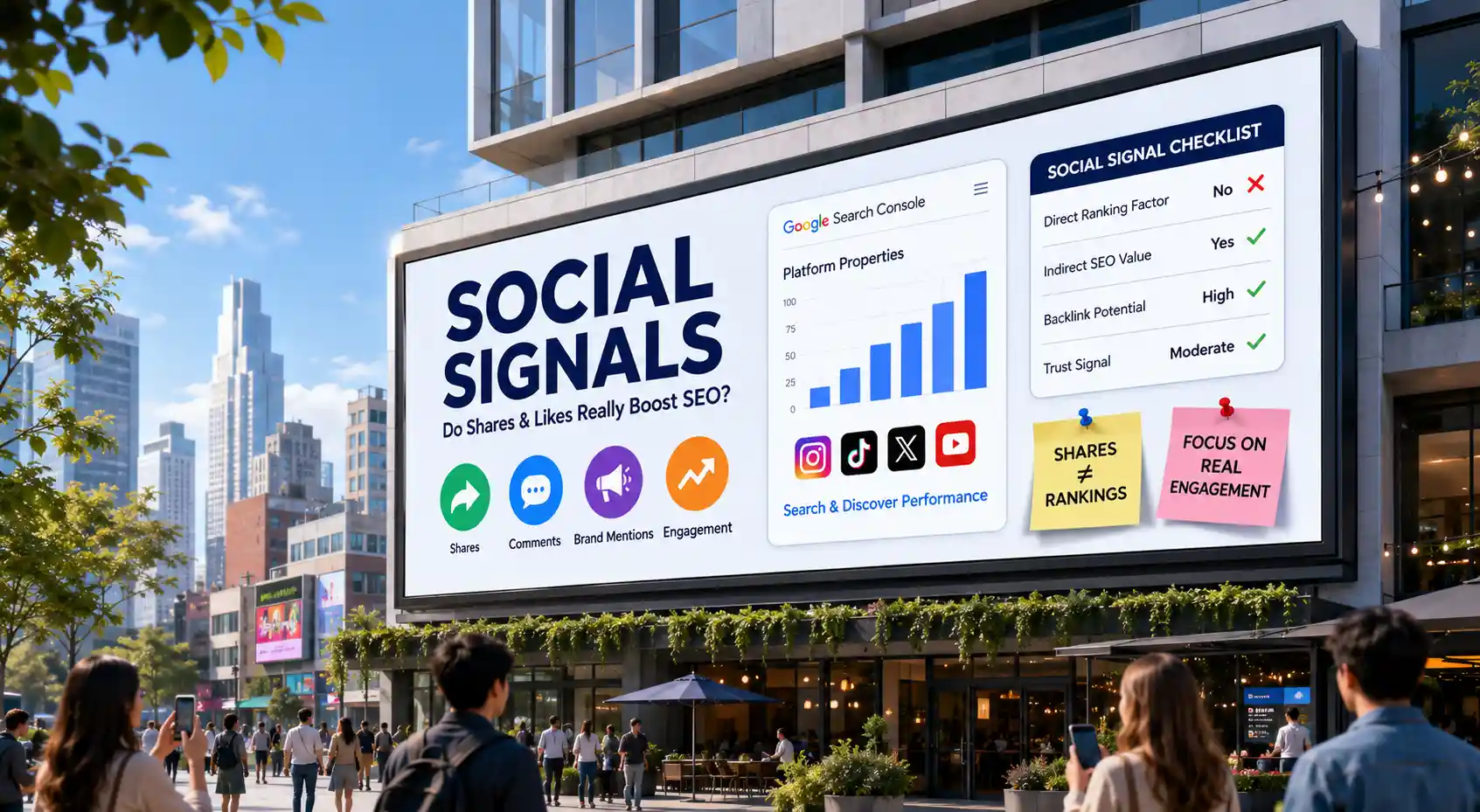
Social Signals get blamed for a lot — and credited for even more — depending on who you ask in the SEO world. You’ve probably seen it happen: a post blows up, the shares roll in, and you wait for your rankings to follow. Then you check Google Search Console and… nothing. So which is it — do these signals actually move the needle, or not? After digging into this across different niches, here’s what I’ve actually found — and it’s not the answer either camp expects.
What Are Social Signals?
Social signals are the engagement metrics your content generates on social media — likes, shares, comments, retweets, and follower counts — that indicate how people are interacting with your brand online. Think of them as the internet’s version of word-of-mouth: every share is someone vouching for your content, every comment is a mini conversation happening in public, and every follow is a small vote of trust.
Here’s where it gets interesting for SEO, though. Social signals aren’t a single, official ranking factor Google plugs into its algorithm. They’re more like a proxy — a stand-in for real-world relevance, authority, and audience trust. And that distinction matters more than most people realize, which is exactly what we’ll unpack throughout this article.
Examples of Social Signals
- Likes and reactions
The quickest form of engagement, showing immediate approval. - Shares and retweets
The strongest signal, since someone is actively vouching for your content to their own audience. - Comments
Indicate deeper engagement and often spark additional visibility through platform algorithms. - Follower/subscriber count
A longer-term trust signal that builds authority over time. - Brand mentions
When people talk about your brand without tagging or linking, still a form of social proof. - Click-through rate on social posts
Shows how compelling your content is at driving action, not just attention.
Are Social Signals a Google Ranking Factor?
This is probably the question that brought you here, and I get why — it’s the one that splits SEO forums into two camps who never seem to agree. On one side, you’ve got people swearing their rankings jumped right after a post took off. On the other, you’ve got Google itself, which has been answering this exact question, the same way, for over a decade. So let’s settle it properly: what has Google actually said, and why does the myth keep coming back anyway?
What Google Has Officially Said
This isn’t a new take, either. Google has been asked this question so many times over the years that there’s a well-documented paper trail. Back in 2015, Google’s John Mueller confirmed that social signals are not a direct ranking factor — full stop. He’s repeated the same position multiple times since, including guidance in 2016 to use social media to add value for users rather than chase rankings with it.
Gary Illyes has echoed the same stance, going so far as to compare the ranking value of social shares to a single drop in the ocean for PageRank. And Matt Cutts, back when he led Google’s Search Quality team, explained that social platform pages get crawled and indexed like any other page — there’s no special social boost baked in.
So if you’re hoping a viral moment is secretly padding your ranking score, it isn’t — at least, not in the way most people assume.
What SEOs Believe Anyway
Here’s why the myth refuses to die: the correlation is real, even if the causation isn’t. A blog post goes viral on Facebook and quickly ranks on page one. An influencer shares a product link on X, and domain visibility spikes. A video trends on TikTok and starts showing up in Google Video results. Watch that happen enough times, and it’s easy to assume the shares themselves are doing the heavy lifting.
I think about it like this: wealthy people tend to drive nice cars, but buying a nice car doesn’t make you wealthy. The same logic applies here — viral content often ranks well, but that’s usually because of everything the virality triggers, not the shares themselves. More eyeballs mean more chances someone links to you, cites you, or searches your brand name directly — and those are real ranking factors. The shares are just the spark, not the fuel.
How Do Social Signals Affect SEO?
So if social signals aren’t a direct ranking factor, why does every SEO guide (including this one) insist they still matter? Because “not a ranking factor” doesn’t mean “no effect.” It just means the effect works through a side door instead of the front one. Once you see how that chain reaction actually plays out, it becomes a lot easier to know where to focus your energy.
Indirect Ranking Influence
Think of social signals as an amplifier, not an ingredient. They don’t get baked into Google’s algorithm directly, but they make everything that is baked in happen faster. More people seeing your content means more people linking to it, quoting it, or building on it — and links, relevance, and authority are the things Google actually scores.
Increased Content Visibility & Indexing Speed
When a page gets shared widely, it often gets crawled and picked up by Google faster, simply because there are more paths leading back to it — more mentions, more embedded links, more places pointing search engines in its direction. For fresh content especially, that can shave real time off how long it takes to start showing up in search results.
Brand Search Volume
Here’s an underrated one. When people see your brand repeatedly on social media, some of them don’t click the post at all — they open a new tab and Google you directly. That branded search volume is a trust signal in its own right, and it’s one Google can measure with total confidence, unlike a like count that could easily be bought or bot-generated.
Referral Traffic
And then there’s the simplest effect of all: traffic. Social platforms send real visitors to your site, and real visitors generate real engagement data — time on page, return visits, pages per session. None of that is “social,” technically, but all of it feeds straight into how Google evaluates whether your content is worth ranking.
What Are the Most Important Social Signals for SEO?
Not all social signals pull the same weight. If you’re spreading your effort evenly across likes, shares, comments, and followers, you’re probably wasting some of it. From what I’ve seen, a handful of these actually matter for the indirect SEO benefits we just covered — the rest are more like vanity metrics that feel good but don’t move much.
- Shares
This is the heavyweight. A share means someone is putting their own name behind your content and handing it to their audience. That’s the exact behavior that leads to backlinks, brand mentions, and referral traffic — the things that genuinely help your SEO. - Comments
Comments signal depth. A like takes half a second; a comment means someone stopped, read, and had a reaction worth typing out. Platforms reward that with extra visibility, and it also tends to correlate with content that’s actually worth linking to later. - Brand Mentions
Not every mention comes with a tag or a link, but Google increasingly treats unlinked brand mentions as a trust signal — especially with how entity recognition has evolved. If people are talking about you by name, that’s real-world authority building, even without a clickable link attached. - Follower/Subscriber Count
This one’s more of a slow-burn signal. It won’t move the needle overnight, but a steadily growing, engaged following builds the kind of long-term brand authority that shows up in branded search volume — which, as we covered earlier, is something Google can measure directly. - Engagement Rate
Raw numbers can be misleading — a huge follower count with barely any interaction says less than a small, highly engaged audience. Engagement rate is often a better predictor of whether your content is actually resonating, which is what eventually earns links and mentions in the first place.
Social Signals on Different Platforms
Here’s something most guides gloss over: social signals don’t behave the same way from platform to platform. What counts as a strong signal on TikTok might barely register on LinkedIn, and vice versa. If you’re treating every platform with the same playbook, you’re probably underperforming on at least one of them. Let’s break it down.
Saves and shares are the real currency here, not likes. Instagram’s own algorithm favors content that gets saved (a strong “I want to come back to this” signal) and shared to Stories or DMs, which extends reach well past your existing followers. For SEO purposes, this matters because Instagram content — especially Reels — increasingly surfaces in Google’s visual and video search results, giving you a second discovery channel beyond the app itself.
TikTok
TikTok runs almost entirely on completion rate and shares, not follower count. A video from a small account can outperform one from a huge account if it holds attention and gets duetted or shared. The SEO angle: TikTok content now shows up directly in Google Search results for a growing number of queries, particularly “how to” and product-comparison searches — meaning your TikTok strategy is quietly becoming part of your search visibility strategy too.
Comments carry more weight than almost anywhere else on LinkedIn, largely because the platform’s algorithm rewards discussion-driving posts with extended reach. For B2B brands especially, LinkedIn engagement often correlates with something more valuable than traffic: it builds the kind of professional authority and brand recognition that shows up later as branded search queries and natural backlinks from industry sites.
X (Twitter)
Retweets (now reposts) still function the way shares do everywhere else — amplification to a new audience. But X has a unique SEO quirk: tweets are indexed and can show up in Google Search results directly, sometimes within minutes of posting. That makes it one of the fastest ways to get a piece of content or a quote in front of Google’s crawlers, even before your main content is fully indexed.
YouTube
YouTube functions almost like a second search engine, so its “social signals” behave more like ranking factors in their own right. Watch time, likes, and comments influence YouTube’s algorithm directly, and because Google owns YouTube, video content frequently earns prime placement in regular Google search results too — making it one of the most SEO-relevant platforms on this entire list.
How to Improve Social Signals for SEO
Alright, this is the part you’ve probably been waiting for — the actual “what do I do about it” section. Improving your social signals isn’t about gaming the numbers; it’s about making your content genuinely worth sharing, then removing every bit of friction between “I like this” and “I’m sharing this.” Here’s how I’d approach it.
- Make Your Content Shareable by Design
Don’t bolt shareability on after you’ve published — build it in from the start. That means clear takeaways people can screenshot, quotable one-liners, and visuals that make sense even out of context (since most shares happen without the original caption attached). If nothing in your post is easy to lift and repost, don’t be surprised when nothing gets shared. - Add Social Sharing Buttons and Plugins
This sounds basic, but I still see sites skip it. Every extra tap someone has to make to share your content is a chance for them to lose interest and move on. One-click sharing buttons, especially on blog posts and product pages, remove that friction entirely. - Post Consistently, Not Just Frequently
There’s a difference between posting a lot and posting on a rhythm your audience can rely on. Consistency builds the kind of habitual engagement that compounds over time — algorithms tend to reward accounts that show up reliably, and audiences tend to engage more with brands they’ve started to expect content from. - Collaborate With Influencers and Encourage UGC
Nothing scales shares like other people creating content about you. Influencer partnerships and user-generated content campaigns both tap into audiences you don’t already have, and they come with a built-in trust factor that your own posts can’t replicate — people trust other people more than they trust brands. - Cross-Promote Across Channels
Don’t let your best content live and die on one platform. A blog post can become a LinkedIn carousel, a TikTok summary, and a Twitter thread. Each version reaches a different slice of your audience, and each one creates another opportunity for someone to share, mention, or link back to the original.
Social Signals vs Backlinks: Which Is More Important for SEO?
If you’ve read this far, you already know the answer isn’t really a fight — it’s a partnership. But if you’re trying to figure out where to put your limited time and budget, it helps to know exactly what each one brings to the table and where the real leverage is.
Backlinks are still the heavyweight. They’re a confirmed, direct ranking factor — Google has said so consistently for over two decades, and nothing in that stance has changed. Social signals, as we covered earlier, aren’t a ranking factor at all on their own. But here’s the part that matters: social signals are often how you get backlinks in the first place.
Content that spreads on social media gets seen by more bloggers, journalists, and site owners — the exact people who link to things. In other words, both are core pieces of your off-page SEO strategy — the work that builds your site’s authority from outside your own domain — they just play different roles within it.
Here’s how they stack up side by side:
So which one should you prioritize? Honestly, neither in isolation. Backlinks build the authority Google actually scores you on, but social signals are frequently the spark that gets your content in front of the people who create those backlinks. Since both fall under off-page SEO, the smartest move is treating social as your distribution engine and backlinks as your destination — not two competing strategies.
How to Measure Social Signals
You can’t improve what you’re not tracking, and this is where a lot of people get stuck — not because measuring is hard, but because it’s easy to measure the wrong things. Follower count feels satisfying to watch, but it won’t tell you much about whether your social activity is actually helping your SEO. Here’s what I’d actually keep an eye on instead.
- Native Platform Analytics
Start with the built-in tools — Instagram Insights, TikTok Analytics, LinkedIn Analytics, X Analytics. These give you the raw numbers: shares, saves, comments, engagement rate. It’s not glamorous, but it’s the most accurate source for what’s actually happening on each platform, straight from the source. - Google Search Console
This is where you connect the dots to actual SEO impact. Watch for branded search queries increasing after a social push, and keep an eye on impressions or clicks on pages you know got shared heavily. If Google recently rolled out platform properties for your accounts, that’s an even more direct way to see how your social content performs specifically in Search and Discover. - Backlink Tracking Tools
A good backlink tracker lets you monitor whether social spikes are translating into new backlinks. Set up alerts for new links pointing to content you know went viral or got heavily shared — that correlation is exactly what tells you whether your social strategy is doing real SEO work. - Referral Traffic in Analytics
Check your traffic sources regularly. A steady or growing share of referral traffic from social platforms is a strong sign your content is earning organic distribution, not just sitting there waiting to be found. - Brand Mention Tracking
A dedicated mention-tracking tool can catch unlinked mentions — the ones that don’t show up in backlink checkers but still count as real-world social proof. This is often the most overlooked metric, and honestly one of the most valuable.
Google Search Console Now Tracks Social Signals: What It Means for SEO
Remember how I said earlier this article that Google doesn’t officially use social signals as a ranking factor? That’s still true — but Google just made a move that’s worth pausing on, because it changes how much visibility you get into your own social performance.
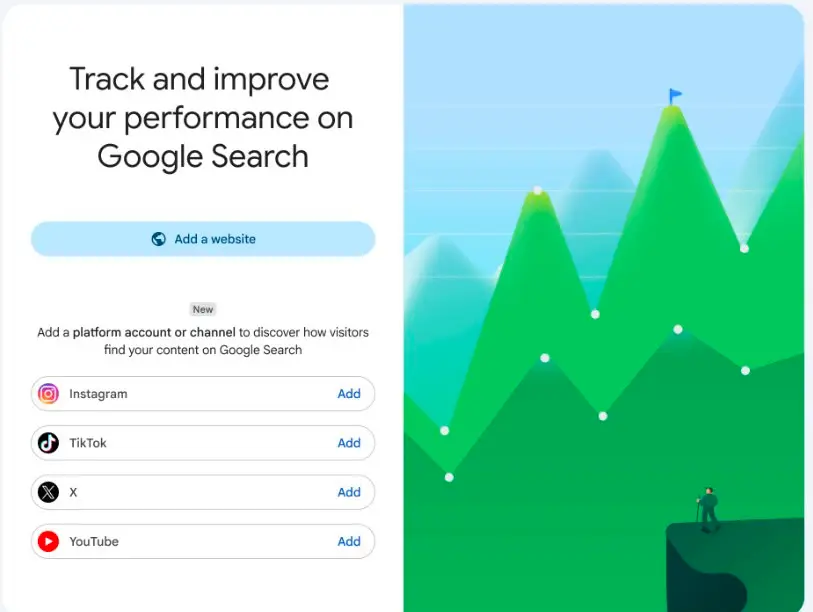
In July 2026, Google introduced a new property type inside Search Console called platform properties, announced by Moshe Samet, Product Manager Lead for Search Console. For the first time, you can connect your Instagram, TikTok, X, and YouTube accounts directly to Search Console and see how those posts perform in Google Search and Discover — which search terms lead people to them, and how your audience interacts with that content once they arrive. It’s even available to creators who don’t run a website at all, which is a first for the platform.
Here’s the part I want to be really clear about, though, because it’s easy to get excited and misread this: this is a measurement feature, not a ranking boost. Connecting your accounts doesn’t make Google start ranking your website higher because of your social activity. What it does do is finally close a blind spot that’s existed for years — you could always see your website’s Search Console data, but your social and video content lived in a black box with no visibility into how it surfaced on Google at all.
The real value here is strategic, not algorithmic. If a topic performs well for you on TikTok or YouTube in Search, that’s a strong signal you should be covering it well on your own site too. It’s a new data point to inform your content strategy, not a shortcut to higher rankings. Given everything we’ve covered in this article, that distinction should feel familiar by now — social and search are connected, just not in the direct way most people assume.
Master Social Signals with Tsabit Insight
Social signals aren’t something you optimize once and move on from — they shift as platforms evolve, algorithms change, and your audience’s habits change with them. If you’ve made it this far through the guide, you already know there’s a lot to juggle: platforms, metrics, backlinks, and knowing which levers actually matter for SEO versus which ones just feel productive.
The good news is, you don’t have to figure it all out alone. At Tsabit Insight, I provide freelance SEO services built around exactly this kind of work — turning social visibility into real SEO outcomes, not just engagement numbers that look nice on a dashboard. Every project starts with understanding your goals and your audience, the same way this guide did, before any platform strategy or tracking tool gets involved.
Whether you’re trying to build a social presence that actually supports your rankings, or you’re already active but not seeing it translate into traffic and backlinks, the approach stays grounded in what genuinely drives results — not just what looks good in a report.
If you’re looking for a reliable freelance SEO specialist to help turn your social strategy into real search visibility, contact me to discuss your project and discover how Tsabit Insight can help your business grow through smarter, more connected SEO.
FAQ