Local SEO Guide and Why the Businesses Down the Street Are Beating You on Google
Local SEO changed the way I look at every business I’ve ever worked with, and these days, it’s probably changing the way your customers find you whether you’ve clocked it or not.
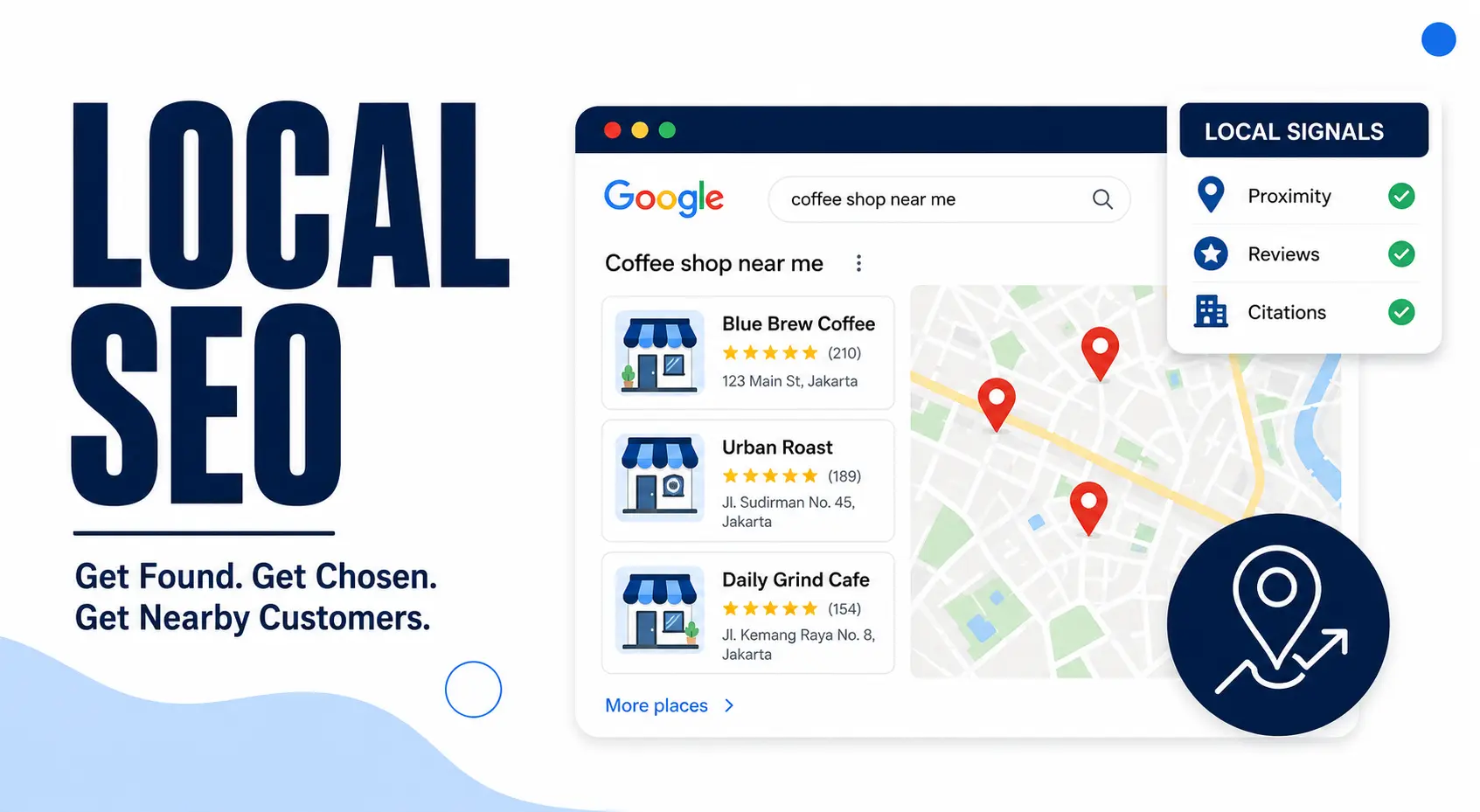
Here’s what I mean. Think about the last time you needed a plumber, a coffee shop, or a dentist nearby. You didn’t scroll through ten pages of Google results, you probably searched something like “best coffee shop near me,” had a quick look at the top three options Google served up, checked the reviews, and picked one. That’s it. Whole decision made in under thirty seconds.
If your business wasn’t one of those top three, you weren’t even in the running.
I’ve spent years watching business owners tip money into flashy websites and broad SEO campaigns while completely missing this moment, the exact second a nearby customer is ready to buy and just needs to know you’re there. That’s the gap Local SEO closes, and it’s a fair bit more personal than people expect. It’s not about outranking the whole internet. It’s about outranking the five other businesses on your actual street, in your actual suburb, competing for the same customer walking past your shopfront right now.
What Is Local SEO?
Local SEO is the practice of optimising your online presence so your business shows up when people nearby search for what you offer, think “near me” searches, suburb-specific queries, and the Google Map Pack that pops up above the regular search results.
I like to think of it as digital word of mouth, except instead of relying on your neighbour mentioning your bakery at a barbecue, Google’s doing the recommending for you, thousands of times a day, to people who are actively looking to buy.
At its core, Local SEO comes down to three things. Your Google Business Profile, which acts like your shopfront sign in the search results. Your local citations, meaning how consistently your business name, address, and phone number show up across the web. And your reviews, which act as social proof the same way a packed cafe on a Saturday morning tells passersby “this place is worth queuing for.”
Unlike traditional SEO, which fights for visibility on a national or global scale, Local SEO narrows the battlefield to your actual service area. You’re not trying to beat Amazon. You’re trying to beat the two other electricians in your postcode, and that’s a fight you can actually win.
How Does Local SEO Work?
Local SEO works by feeding Google enough signals to trust that your business is real, relevant, and physically close to the person searching. Google isn’t guessing where to send customers, it’s matching intent, location, and credibility, all at once, in the time it takes someone to glance at their phone.
Here’s how that plays out in practice. When someone searches “yoga studio near me,” Google looks at their location first, then scans nearby businesses that match the intent behind that search. From there, it weighs three things. How relevant your business is to the search, do you actually offer yoga classes. How close you are to the searcher. And how prominent your business is online, based on reviews, backlinks, and how often people mention or search for you by name.
This is why I always tell business owners that Local SEO isn’t a one-time setup. It’s more like tending a veggie patch than flipping a switch. Google’s constantly re-evaluating these signals, which means the businesses that stay visible are the ones consistently reinforcing them — fresh reviews coming in, accurate business information, regular activity on their Google Business Profile, and content that keeps confirming “yep, we’re still here, and we’re still the right choice.”
The businesses that treat Local SEO as a checklist item they did once tend to fade out of the map pack within a few months. The ones that treat it as an ongoing relationship with their local audience are the ones I see holding that top spot year after year.
Also Read: Google Maps SEO Guide to Rank Higher and Get Found by Local Customers
Why Is Local SEO Important for Businesses?
If you’re a business that serves customers in a physical location or a set service area, Local SEO isn’t optional these days. It’s the difference between being found and being invisible.
Here’s why it matters so much. Nearly half of all Google searches carry local intent, meaning the person typing that query is after something nearby, right now, ready to act. They’re not researching for next month. They’re deciding where to go today. And when someone’s that close to a buying decision, showing up in the map pack isn’t just nice visibility, it’s the whole ballgame.
A strong local presence does more than get you seen. It does a fair bit of the persuading before you’ve even said a word.
- Builds trust instantly
A complete Google Business Profile paired with consistent Google Business Review activity tells a stranger you’re legit before they’ve even picked up the phone - Keeps you from losing silently
If a competitor shows up and you don’t, the customer never even knows you were an option - Levels the playing field
You don’t need a national chain’s budget to outrank one in your own backyard, just consistency and proof you’re the better local choice
That last point is the one I really want business owners to sit with. I’ve seen businesses with a modest budget outrank far bigger names simply because they kept their Google Business Profile up to date and stayed on top of their Google Business Review responses week after week. Local SEO isn’t about out-spending anyone. It’s about being the business Google trusts enough to recommend, and that’s a fight small businesses can genuinely win.
Also Read: The Complete Guide of International SEO to Ranking in Global Markets
Local SEO vs Traditional SEO
People ask me this all the time, usually right after they’ve spent months chasing rankings that never actually brought a single customer through the door. So, let’s clear it up properly.
The simplest way I can put it is this. Traditional SEO fights for attention everywhere. Local SEO fights for attention right where your customers already are. Both matter, but they’re playing completely different games, with different rules and different scoreboards.
Traditional SEO is what most people picture when they think of SEO: ranking a blog post or product page for a broad keyword that anyone, anywhere in the world might search. Local SEO narrows that same effort down to one question: when someone nearby needs what you offer, will Google put your business in front of them?
Here’s how the two actually stack up side by side.
What I find most business owners miss is that these two aren’t actually rivals; they work best together. Your traditional SEO builds the authority and content depth that helps Google trust your website overall, while your Local SEO makes sure that trust translates into foot traffic, phone calls, and enquiries from people in your area. If you only invest in one, you’re leaving half the opportunity on the table.
How to Create a Local SEO Strategy
This is the part I get asked about the most, because everyone wants a shortcut and the honest truth is there isn’t one, just a clear sequence that works if you actually follow it, step by step, without skipping ahead. What follows is the exact order I walk businesses through, and each piece builds on the one before it, so resist the urge to jump straight to the end.
Claim and Optimise Your Google Business Profile
Everything starts here. I always tell business owners that an incomplete Google Business Profile is like opening a shop and leaving the sign in the box, you might technically be open, but nobody walking past would know it.
Fill out every section Google gives you, not just the basics. Add your hours, your services, decent photos, your business description, and keep it updated whenever anything changes. This profile is often the very first impression a potential customer gets of you, before they’ve even landed on your website.
Nail Your NAP Consistency
NAP stands for name, address, and phone number, and it needs to match word for word everywhere it appears online — your website, your Google Business Profile, your social media, every directory listing.
I’ve seen businesses lose local rankings simply because one directory listed “St.” and another listed “Street.” Sounds minor, but Google reads inconsistency as a red flag, and it can quietly undercut every other effort you’re making.
Build Local Citations
A citation is any online mention of your business name, address, and phone number, even without a link back to your site. The goal is getting listed on directories Google already trusts, especially ones specific to your industry or region.
Think of citations as votes of confidence. The more consistent, credible mentions you’ve got scattered across the web, the more Google trusts that your business is real, active, and worth recommending.
Optimise for Local Keywords
This means weaving your suburb, city, or service area naturally into your website copy, page titles, and headers — not stuffing it in awkwardly, but writing the way you’d actually talk to a local customer.
Instead of a generic “plumbing services,” you’d write “plumbing services in Bondi” or “emergency plumber serving the Eastern Suburbs.” Small shift, but it tells Google exactly who you’re trying to reach.
Collect and Respond to Reviews
Reviews do double duty. They act as social proof for potential customers deciding whether to trust you, and they act as a ranking signal Google actively weighs. What I always stress is the responding part — every reply, whether the review is glowing or frustrated, shows Google and future customers that you’re actively engaged and paying attention.
A business with fifty reviews and zero responses looks less trustworthy than one with twenty reviews and thoughtful replies to every single one.
Create Locally Relevant Content
This is where most businesses play it too safe. Generic blog content that could apply to any city, anywhere, does very little for your local visibility. Content that speaks directly to your area — local guides, community involvement, area-specific FAQs — signals relevance in a way generic content never will.
Earn Digital PR and Local Mentions
I’ve seen businesses transform their local visibility just by earning mentions from local news outlets, community blogs, or regional publications. Every time a credible local source links back to you or even just mentions your business by name, it reinforces to Google that you’re a real, established presence in that area, not just another listing that popped up overnight.
This is where a lot of businesses stop too early. They build the profile, gather a handful of reviews, and consider the job done. But a real Local SEO strategy isn’t a one-off build. It’s a system you keep feeding, month after month, with fresh signals that tell Google you’re still the right recommendation.
Also Read: Digital PR Guide: Strategy, Cost, Examples, and AI Search Visibility
Local SEO for Multiple Locations
This is where things get genuinely trickier, and it’s a question I get from almost every growing business I work with. Managing Local SEO for one location is one thing. Managing it for five, ten, or fifty locations is an entirely different challenge, and the strategies that worked for a single shopfront can actually work against you if you scale them up carelessly.
Create a Separate Google Business Profile for Each Location
Every single location needs its own Google Business Profile, tied to its own unique address and phone number. I know the temptation is to set up one profile and just list all your locations underneath it, but Google wants to match searchers with the specific location nearest to them, and it can only do that if each location has its own dedicated presence.
Build Location-Specific Landing Pages
Each location also needs its own page on your website, not a single generic “our locations” page listing everything in a table. A dedicated page for your Melbourne location, separate from your Brisbane location, lets you speak directly to that area, mention nearby landmarks, list location-specific hours, and target that city’s local keywords without diluting your message across every location at once.
Keep NAP Consistency Across Every Listing
The NAP consistency in SEO rule doesn’t get easier with scale, it gets harder, and that’s exactly why it matters more. With multiple locations, you’re multiplying the number of places your business information appears, which multiplies the chances of a typo or mismatch slipping through.
I always recommend a spreadsheet tracking every single listing per location, so nothing falls through the cracks as you grow.
Localise Reviews and Content Per Location
Reviews and content need the same location-specific treatment. Encourage customers to leave reviews mentioning their specific visit and location, and create content that speaks to each area individually rather than writing one generic blog post and hoping it resonates everywhere. A customer in Melbourne wants to feel like you’re talking to Melbourne, not reading a copy-pasted version of a Brisbane post with the city name swapped out.
What I’ve learned working with multi-location businesses is that the ones who win here treat each location almost like its own small business with its own identity, rather than treating the whole operation as one entity wearing different name tags. That mindset shift alone changes how customers respond to you at every single location.
Local SEO Ranking Factors
Google doesn’t publish an exact formula for local rankings, but after years of watching what actually moves businesses up and down the map pack, certain factors show up again and again. Here’s what I’ve found genuinely matters, ranked roughly by how much weight I’ve seen them carry in practice.
- Proximity to the Searcher
This one you can’t fully control, and that’s exactly why it matters so much. Google factors in how physically close your business is to the person searching, which means the same query can return completely different results depending on where someone’s standing. It’s a reminder that Local SEO isn’t just about being the best option, it’s about being the best option nearby. - Google Business Profile Completeness and Activity
A fully filled-out, actively maintained Google Business Profile consistently outperforms a bare-bones one. Google rewards businesses that keep their hours accurate, post updates, respond to questions, and add fresh photos regularly, because an active profile signals a business that’s still operating and still worth recommending. - Review Quantity, Quality, and Recency
It’s not just about having a lot of reviews. Google weighs how recent they are, how detailed they are, and whether you’re responding to them. A steady trickle of new reviews tends to outperform a big pile of old ones that stopped coming in two years back. - NAP Consistency Across the Web
Your name, address, and phone number need to match everywhere they appear. Inconsistencies knock Google’s confidence in your business data, and a business Google isn’t confident about isn’t one Google wants to recommend. - Local Citations and Directory Listings
Being listed accurately on trusted directories, especially industry-specific ones, reinforces your legitimacy. Each citation acts like another small vote of confidence telling Google your business is exactly where and what it claims to be. - On-Page Local Signals
This covers how well your actual website content, titles, and headers reflect your location and service area. A page that clearly and naturally mentions your suburb, city, or service area gives Google stronger context than a page that never mentions location at all. - Backlinks from Locally Relevant Sources
Links from local news outlets, community organisations, or regional business associations carry real weight, because they signal that your business is recognised and trusted within your actual community, not just generically popular online. - Behavioural Signals
Google also pays attention to how people interact with your listing — click-through rates, how often people request directions, how often they ring you straight from the search results. High engagement tells Google that real people are finding your business genuinely useful, which reinforces everything else you’re doing right.
Local SEO Tools
Picking the right tools makes the difference between guessing and actually knowing what’s working, so let me walk you through what I actually use with businesses and why each one earns its spot in the toolkit.
No single tool does the whole job for you, and that’s something I wish more business owners cottoned onto before spending their entire budget on one platform. Google Business Profile Manager keeps your foundation solid, citation tools keep your data consistent across the web, and analytics tools show you whether all that effort is actually converting into real traffic and calls. Pick one from each category rather than trying to juggle five tools that all do roughly the same thing.
How to Measure Local SEO Performance
Here’s something I wish more business owners understood early on. Local SEO isn’t something you do and then wonder about. It’s something you can actually watch move, week to week, if you know where to look.
The first place I always check is map pack visibility. Literally, does your business show up in the top three results when someone nearby searches your main keywords? This is the single clearest signal of whether your efforts are translating into real-world visibility, and it’s worth tracking manually or through a rank tracker on a regular basis.
From there, I shift over to your Google Business Profile Insights, which quietly hands you some of the richest data going around for free. This tells you how many people viewed your profile, how many requested directions, how many rang you directly, and how many clicked through to your website. When these numbers climb, it usually means your visibility gains are converting into actual customer actions, not just impressions nobody acts on.
Your Google Search Console data matters just as much, especially once you filter it down to local, city, or “near me” style queries. Watching your impressions and click-through rate for these specific searches tells you whether you’re gaining ground in the exact searches that matter most to your business.
Then there’s the bit a lot of business owners overlook entirely (review velocity). I’m talking about how many new reviews you’re earning per month, and whether that number is climbing, flat, or tapering off. A business with steady review growth almost always outperforms one that got a burst of reviews once and went quiet.
If I had to boil it down to the handful of numbers worth checking every month, it’d be this short list.
- Map pack ranking position for your top keywords
- Google Business Profile views, calls, and direction requests
- Website traffic and conversions specifically from local search
- New review count and average rating trend
None of these numbers mean much on their own. What tells the real story is watching them move together over time because that’s when you know whether your Local SEO is actually working, or just sitting there looking finished.
Also Read: What is On-Page SEO? How to do it
Common Local SEO Mistakes to Avoid
After years of auditing local listings, I keep seeing the same handful of mistakes quietly costing businesses their visibility. None of them are complicated to fix, which is exactly what makes them frustrating; they’re usually just overlooked, not misunderstood.
- Leaving the Google Business Profile Incomplete
This is the mistake I see most often, and it’s the easiest one to fix. A profile missing hours, photos, or a proper description tells Google, and every potential customer, that the business isn’t actively maintained. Even something as small as an outdated public holiday hours listing can quietly cost you customers who show up to a closed door. - Ignoring NAP Inconsistencies
I’ve walked into audits where a business’s phone number was different across five different directories, and nobody on the team had even clocked it. Google reads that inconsistency as a trust issue, and it can hold back rankings even when everything else about the business is solid. - Chasing Reviews Without Responding to Them
Getting reviews is only half the job. I’ve seen businesses with hundreds of reviews and zero responses, which tells Google, and every future customer scrolling through, that nobody’s actually paying attention on the other end. - Using One Generic Page for Multiple Locations
This one comes up constantly with growing businesses. Trying to rank five locations off a single “our locations” page almost never works, because Google can’t tell which location a searcher should actually be matched with. - Neglecting Mobile Experience
Most local searches happen on a phone, in the moment, often while someone’s already out and about. A slow-loading or clunky mobile site loses customers exactly when they’re closest to walking through your door. - Treating Local SEO as a One-Time Setup
This is the mistake underneath most of the others. Local SEO isn’t something you finish. It’s something you maintain, and the businesses that fall out of the map pack are almost always the ones who did the setup once and never looked back.
Also Read: Off-Page SEO: The Complete Guide to Ranking Beyond Your Website
Local SEO Checklist
I’ve covered a fair bit in this article, so let’s turn all of it into something you can actually act on. Below is the exact checklist I use when auditing a business’s Local SEO, broken into the same order you’d realistically tackle it — foundation first, then on-page and content, then the ongoing work that keeps you visible long after the initial setup. Tick off what you’ve already sorted, and let the rest guide what to tackle next.
Show Up Where Your Customers Are Searching with Tsabit Insight
Local SEO isn’t a project you finish and walk away from; it’s something that needs attention as your business grows, as competitors adjust, and as Google keeps refining what it rewards. If you’ve read this far, you already know how many moving pieces there are to manage well. The good news is you don’t have to manage all of it on your own.
At Tsabit Insight, I offer freelance SEO services built around exactly this kind of work — optimising your Google Business Profile, tightening up your citations, and turning local visibility into real foot traffic and phone calls. Every project starts with understanding your business and your local market, the same way this guide did, before any tool or checklist comes into play. Whether you’re setting up your Local SEO for the first time or trying to fix a strategy that’s stopped delivering, the approach stays focused on what actually moves your ranking, not just what looks tidy on a report.
If you’re after a reliable freelance SEO specialist to help your business get found by the customers nearest to you, get in touch to talk through your project and see how Tsabit Insight can help you grow through smarter, more targeted local visibility.

FAQ