What is On-Page SEO? How to Do It
On-Page SEO is one of those things that looks straightforward on the surface, tweak a title tag here, add a keyword there, but there’s a lot more going on underneath. Most people underestimate how much it actually influences where their page ends up on Google, and more often than not, that’s exactly where rankings start to slip. And unlike a lot of SEO tactics that depend on what others do, this one is entirely in your hands. That’s what makes it both exciting and worth getting right.
What is On-Page SEO?
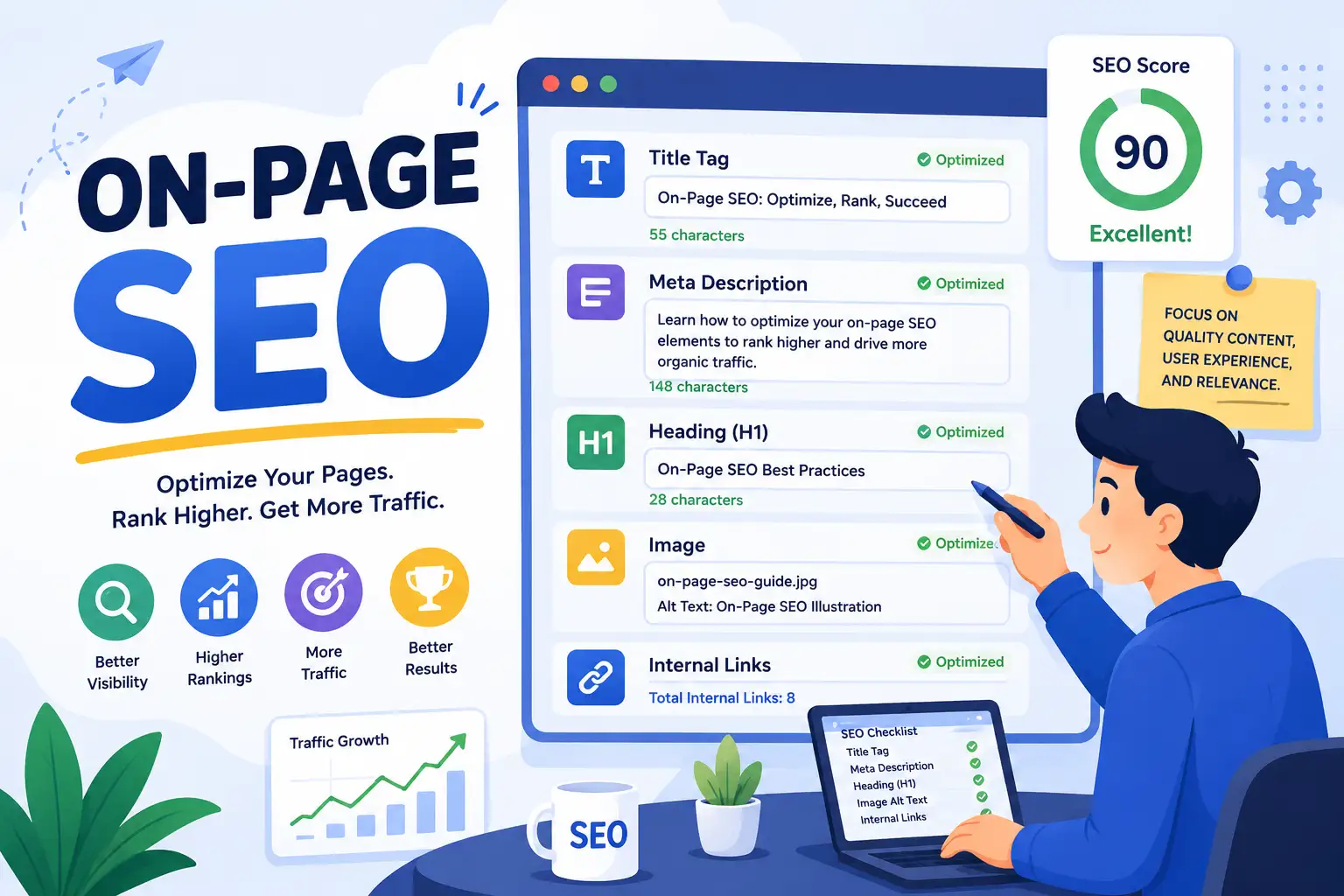
On-Page SEO is the process of optimising the elements on a webpage to improve its visibility and ranking in search engine results pages (SERPs). This includes everything from your content and headings to your title tags, meta descriptions, internal links, image alt text, and URL structure, essentially anything that lives directly on the page itself.
Think of it this way: Google sends out crawlers to read and evaluate your pages, much like a lecturer marking an assignment. If your page is well-structured, clearly written, and answers what the reader is actually looking for, you’re going to score well. If it’s a mess of unrelated content with no clear focus, don’t expect a gold star.
On-Page SEO vs Off-Page SEO
These two terms get thrown around a lot together, but they refer to very different sides of the SEO coin. On-page SEO is everything you control directly on your website — your content, structure, and technical elements on the page itself. Off-page SEO, on the other hand, is about building your site’s authority and reputation through external signals, primarily backlinks from other websites. Both matter for rankings, but they require completely different approaches and skill sets.
Why On-Page SEO is Important for Google Rankings
A lot of people treat on-page SEO as a box-ticking exercise — stuff a few keywords in, write a meta description, and call it a day. But Google has come a long way from the days when that was enough. Today, its algorithm evaluates hundreds of on-page signals to decide whether your page genuinely deserves to rank, and if you’re not paying attention to those signals, you’re essentially leaving your rankings up to chance.
The most fundamental reason on-page SEO matters is that it helps Google understand what your page is actually about. Search engines can’t read your content the way a human does — they rely on structured signals like your title tag, headings, keyword usage, and internal links to piece together the context of your page. Get those signals right, and you dramatically improve your chances of showing up for the right queries.
Beyond that, on-page SEO directly influences user experience — and Google pays close attention to how users interact with your page. If your content is well-structured, easy to read, and genuinely answers what someone was searching for, they’ll stick around longer. That sends positive signals back to Google, reinforcing that your page is worth ranking. On the flip side, if your page is poorly organised and people bounce within seconds, don’t expect to hold a strong position for long.
Simply put, on-page SEO is the foundation everything else sits on. You can build the strongest backlink profile in your niche, but if the page itself isn’t optimised, you’re fighting an uphill battle that doesn’t need to be that hard.
Also Read: The Complete Guide to Technical SEO And Why Your Content Isn’t Ranking Without It
How to Do On-Page SEO?
Knowing that on-page SEO matters is one thing — actually doing it properly is another. The good news is that it doesn’t have to be overwhelming. At its core, on-page SEO comes down to a series of deliberate decisions you make every time you publish or update a page. Here’s how to approach it step by step.
Start with keyword research
Before you write a single word, you need to nail down your keyword research — knowing exactly what your target audience is actually searching for. Use tools like Google Keyword Planner, Ahrefs, or Ubersuggest to find your primary keyword and a handful of related terms. Your primary keyword should appear in your title tag, H1, first paragraph, and naturally throughout the body — not forced in, but woven in where it makes sense.
Optimise your title tag and meta description
Your title tag is one of the strongest on-page signals Google reads. Keep it under 60 characters, lead with your primary keyword, and make it compelling enough that people actually want to click. Your meta description won’t directly boost rankings, but a well-written one improves your click-through rate — which does matter.
Structure your content with proper headings
Use your H1 for the page title, and break the rest of your content into H2s and H3s. A clear heading hierarchy doesn’t just help Google crawl your page — it makes your content significantly easier to read. Think of headings as signposts that guide both the reader and the search engine through your page.
Write content that genuinely answers the search intent
This is where most pages either win or lose. Google’s job is to match search queries with the most relevant, helpful content — so ask yourself: does my page actually answer what someone typing this query wants to know? Thin, vague content that dances around the topic will never outrank a page that directly addresses the reader’s question.
Optimise your images
Every image on your page should have a descriptive file name and an alt text that tells Google what the image shows. This not only helps with image search rankings but also improves accessibility — two wins for the price of one.
Sort out your URL structure
Keep your URLs short, descriptive, and keyword-rich. A URL like tsabit-insight.com/on-page-seo will always outperform something like tsabit-insight.com/p=1234. Clean URLs are easier for both Google and users to understand at a glance.
Build internal links
Every time you publish a new page, link it to relevant existing pages on your site, and link those pages back to it where it makes sense. Internal linking distributes authority across your site and helps Google discover and index your content faster.
Also Read: The Complete Guide of International SEO to Ranking in Global Markets
On-Page SEO Mistakes
Even experienced marketers fall into these traps. The thing about on-page SEO mistakes is that they’re rarely obvious — your page still goes live, it still gets indexed, and it might even get some traffic. But under the surface, these mistakes are quietly holding your rankings back. Here are the most common ones to watch out for.
Keyword Stuffing
This one’s been around since the early days of SEO and yet it still happens. Forcing your keyword into every other sentence doesn’t make your page more relevant — it makes it harder to read and flags your content as low quality to Google. Modern search algorithms are sophisticated enough to understand context, so focus on writing naturally and let the keyword appear where it genuinely fits.
Ignoring Search Intent
You can tick every on-page box perfectly and still fail to rank if your content doesn’t match what the searcher actually wants. Search intent is the why behind a query — whether someone is looking to learn something, buy something, or find a specific page. If your content format or angle doesn’t align with that intent, Google simply won’t serve it to the right audience.
Duplicate Title Tags and Meta Descriptions
Having the same title tag or meta description across multiple pages is one of the most common — and easily avoidable — on-page mistakes. Every page on your site should have a unique title tag and meta description that accurately reflects that specific page’s content. Duplicates confuse search engines and dilute the relevance signals you’re trying to send.
Skipping the Title Tag Altogether
Some CMS platforms auto-generate title tags from your page title, and many site owners never bother to customise them. A generic or auto-generated title tag is a missed opportunity to signal relevance to Google and earn clicks from real users. Always write your title tags manually and treat them as one of your highest-priority on-page elements.
Poor URL Structure
Long, messy URLs filled with numbers, symbols, or irrelevant parameters are bad for both SEO and user experience. Your URL should be short, descriptive, and include your primary keyword — nothing more, nothing less. Changing URLs on existing pages can also cause issues if redirects aren’t set up properly, so get this right from the start.
Thin or Shallow Content
Publishing a 300-word page and expecting it to compete with comprehensive, well-researched content is optimistic at best. Google consistently favours pages that cover a topic in depth and provide genuine value to the reader. If your content doesn’t go beyond surface-level information, it’s going to struggle — no matter how well you’ve optimised everything else.
Neglecting Internal Links
A page with no internal links is essentially an island — Google can find it, but it won’t understand how it connects to the rest of your site. Every page you publish should link to relevant existing content and be linked to from other pages where it makes sense. Neglecting internal links means you’re leaving authority and crawl equity on the table.
Not Optimising Images
Uploading images without compressing them, naming them something like “IMG_4821.jpg,” and leaving the alt text blank is a triple mistake that’s incredibly common. Unoptimised images slow your page down, miss an indexing opportunity, and provide no accessibility value whatsoever. Take the extra two minutes to compress, rename, and write proper alt text for every image you upload.
Writing for Algorithms Instead of People
This is perhaps the most ironic mistake of all — spending so much time optimising for Google that you forget there’s a human being on the other end of that search query. Google’s entire goal is to surface content that genuinely helps people, so the best SEO strategy and the best user experience strategy are ultimately the same thing. Write clearly, structure thoughtfully, and solve the reader’s problem — the rankings tend to follow.

Optimise Your On-Page SEO with Tsabit Insight
On-page SEO isn’t a one-time fix — it’s an ongoing process that requires a sharp eye, consistent effort, and a clear understanding of what Google actually rewards. And if you’ve made it this far through the guide, you already know there’s a lot to get right. The good news is, you don’t have to figure it all out on your own.
At Tsabit Insight, I provide freelance SEO services focused on improving on-page performance through practical, data-driven strategies. Every project involves auditing pages, refining content structure, fixing the technical details that quietly hold rankings back, and building sustainable SEO strategies that deliver long-term growth. Whether you’re launching a new website or trying to push existing pages higher in the SERPs, the approach is always grounded in what actually moves the needle—not what simply looks impressive in a report.
If you’re looking for a reliable freelance SEO specialist to strengthen your website’s organic performance, contact me to discuss your project and discover how Tsabit Insight can help your business achieve sustainable search growth.
FAQ