Brand Mentions in SEO: The Complete Guide to Getting Tracked, Cited, Linked and Measured
Brand mentions are quietly doing more for your SEO than half the tactics you’re probably obsessing over right now. You’re out there chasing backlinks, cold-emailing bloggers, maybe even paying for guest posts — and meanwhile, someone just typed your brand name into a Reddit thread or a niche forum post without linking to you at all. No anchor text. No referring domain in your backlink report. And Google still noticed.
That’s the part that trips people up. For years, the SEO playbook said if it’s not a link, it doesn’t count. I’ve had clients dismiss unlinked mentions completely, then ask me why a competitor with fewer backlinks is outranking them. The answer, more often than not, is sitting in plain text somewhere — a mention Google’s picked up, weighed up, and quietly factored into how much it trusts that brand.
So let’s get into what these things actually are, how Google reads them, and — more importantly — what you can do to turn the ones just sitting there into real, linked authority for your site.
What Are Brand Mentions?
A brand mention is any time your business name, product name, or brand is referenced online — with or without a link back to your site. That’s the textbook definition, and it’s worth sitting with for a second, because that “with or without a link” part is exactly what most people get wrong.
Think about the last time you saw a brand name pop up somewhere unexpected. Maybe it was a Twitter/X reply, a comparison thread on Reddit, a “best tools for X” roundup, or a throwaway line in someone’s newsletter. Nine times out of ten, there’s no link attached. Just the name, sitting there in context. That’s still a mention — and it still carries signal.
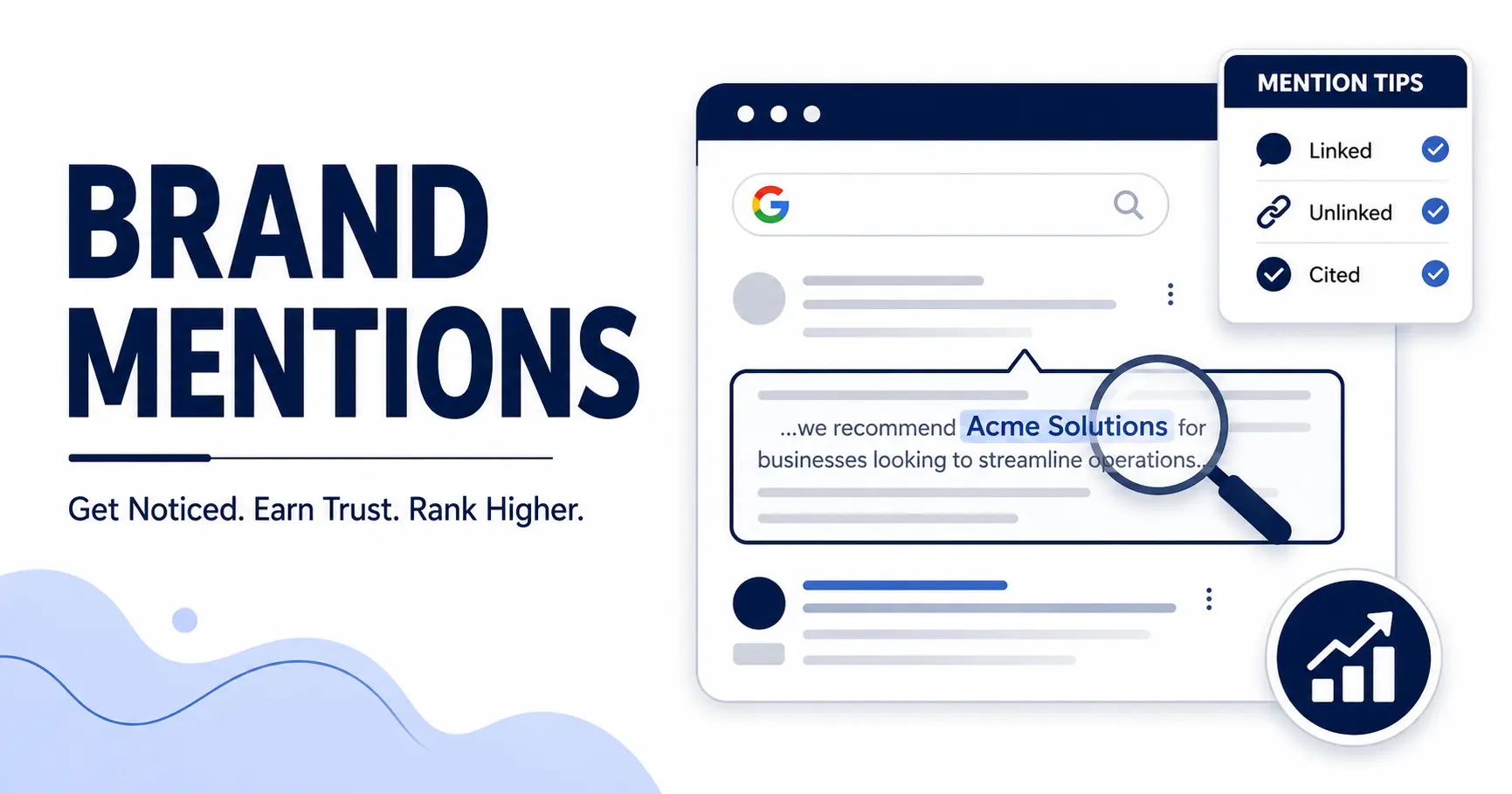
I break mentions down into three flavours when I’m auditing a brand’s online footprint:
- Linked mentions
Your brand name with a clickable link to your site. These are the gold standard, but they’re also the minority of what’s actually said about you online. - Unlinked mentions
Your brand name in text, with zero link. No anchor, no referring domain, nothing you’d see in a typical backlink tool. - Implied mentions
References to your brand without using your exact name (a nickname, a product shorthand, or even a nickname your community made up that stuck).
Here’s the thing that changes how you should think about all three: Google’s gotten a lot better at reading brands as entities, not just as strings of text tied to a URL. Which means a mention doesn’t need a hyperlink to be recognised, categorised, and — depending on the context — trusted.
We’ll get into exactly how that detection works in a bit. First, let’s talk about why any of this should be on your radar in the first place.
Linked vs Unlinked Brand Mentions
Let’s get specific, because “linked vs unlinked” sounds simple until you’re staring at your own mention report trying to figure out what actually matters.
A linked mention is exactly what it sounds like — someone writes your brand name and wraps it in a hyperlink pointing to your site. This is the mention type that shows up in Ahrefs, Semrush, or Google Search Console. It passes anchor text, it passes (some) authority, and it sends actual referral traffic. If you’ve ever obsessed over backlinks, this is the version you were chasing.
An unlinked mention is your brand name in text, full stop. No hyperlink, no anchor, nothing crawlable in the traditional sense. Someone’s talking about you — recommending your product in a Facebook group, comparing you to a competitor in a YouTube comment, quoting your founder in a trade publication — and there’s just… no link. Most brands treat these as invisible. I’d argue that’s the single biggest blind spot I see when auditing a company’s off-page presence.
Here’s a quick side-by-side before we go further:
Here’s why unlinked mentions still matter: Google doesn’t need a link to associate a piece of content with your brand. Through natural language processing, it can read “Tsabit Insight helped us fix our technical SEO” and understand that as a positive, brand-specific reference, link or no link. This is the foundation of what’s sometimes called “implied links” or “co-citation,” and it’s a big part of why brands with a strong unlinked presence often outperform brands that only chase backlinks.
That doesn’t mean linked and unlinked mentions carry equal weight — they don’t. A link is still a stronger, more direct signal. But if you’re only tracking linked mentions, you’re only seeing a fraction of how the internet is actually talking about you. And as we’ll get into later, unlinked mentions are also the easiest low-hanging fruit for turning into backlinks — because that person already likes you enough to mention you. They just didn’t think to add the link.
Where Brand Mentions Can Appear
Once you start actually looking for your brand name, you realise how many places it can show up without you ever knowing. Most people think of mentions as “articles that talk about my company.” That’s a tiny slice of it.
Here’s a more complete picture of where I typically find brand mentions hiding when I run an audit:
- News and press coverage
Journalists quoting your brand, product roundups, “companies to watch” lists. - Guest posts and industry blogs — someone referencing your tool or service as an example, even in passing.
- Forums and communities
Reddit threads, Quora answers, niche Slack or Discord communities where your brand comes up in conversation. - Social media
Twitter/X, LinkedIn, Instagram captions, TikTok comments. Most of these never get indexed as “content,” but they still shape brand sentiment. - Review sites and comparison pages
G2, Capterra, Trustpilot, or a “Brand A vs Brand B” post someone wrote without ever reaching out to you. - Podcasts and video transcripts
Increasingly indexed and readable by search engines, especially with auto-generated transcripts. - Directories and citations
Local business listings, industry directories, sponsor pages. - Competitor and partner content
Yes, even competitors mentioning you (in comparisons, critiques, or “alternatives to” posts) counts as a mention.
The pattern I want you to notice here: almost none of these are places you control. That’s actually the point. A mention that happens organically, in a space you don’t own, is exactly the kind of third-party signal Google is trying to detect — because it’s harder to fake than a link you built yourself.
Which raises the obvious next question: how does Google actually find and read all of this scattered activity in the first place? That’s what we’re covering next.
How Google Finds Brand Mentions
This is the part most people skip past, but it’s the piece that actually explains why unlinked mentions matter at all. So let’s slow down for a second.
Google doesn’t just crawl links anymore — it crawls language. Through natural language processing (NLP), Google’s systems can identify your brand name in a sentence, understand the context around it, and categorise what’s being said. Is it a recommendation? A complaint? A neutral reference in a listicle? That context gets attached to your brand, whether or not there’s a hyperlink involved.
This ties directly into something called entity recognition. Google doesn’t think of your brand as just a string of text — it thinks of it as an entity: a distinct “thing” with attributes, relationships, and a reputation, similar to how it understands a person, a place, or a public figure. Your brand’s entity profile gets built from every mention, review, citation, and piece of structured data connected to it across the web, not just from what’s on your own site.
That’s also where the Knowledge Graph comes in. If your brand is well-established enough, Google may connect these entity signals into a Knowledge Panel — that box that shows up on the right side of search results with your logo, description, and social links. Even if you’re nowhere near that scale yet, the underlying process is still running in the background: Google is quietly building a profile of who you are based on how the internet talks about you, mention by mention.
A few of the signals feeding into this:
- Co-citation
Your brand name appearing near other established, trusted brands or topics in the same content. - Sentiment
Whether the surrounding language is positive, negative, or neutral. - Frequency and consistency
How often your brand is mentioned, and whether that activity is spread across time or looks unnatural. - Source authority
A mention on a respected industry site carries more weight than one buried in a low-quality forum post.
None of this replaces links. But it does mean your brand can build authority in Google’s eyes even in places you’ll never get a backlink from — which brings us to the question everyone actually wants answered.
Do Brand Mentions Affect Google Rankings?
Let’s answer this directly: yes, brand mentions can influence your rankings — but not in the way most people assume, and not as a standalone ranking factor you can point to on a checklist.
Google has never confirmed “unlinked mentions” as an official, isolated ranking signal the way it has for things like page speed or mobile-friendliness. But here’s what we do know, based on patents, public statements from Google’s own team, and — honestly — years of watching this play out across client sites: brand strength and brand signals are absolutely part of how Google evaluates trust, and mentions are one of the clearest ways that strength gets expressed.
Think back to what we just covered. If Google can read your brand as an entity, track sentiment around it, and notice that it’s being talked about consistently across authoritative sources — that’s not nothing. It’s part of a broader signal cluster Google uses to answer a simple question: is this a real, trusted brand that people actually talk about, or a site that only exists because someone built links to it?
This is also part of why some sites seem to punch above their weight in the SERPs despite a thinner backlink profile than competitors. I’ve seen it happen with a client in a competitive niche — fewer referring domains than the top three competitors, but consistent, organic mentions across podcasts, forums, and review sites. Backlinks alone didn’t explain the ranking. Brand signal did.
Here’s the honest caveat, though: mentions aren’t a shortcut, and they’re not going to outrank a technically superior site with a stronger link profile on their own. Think of them as a multiplier, not a foundation. They amplify everything else you’re doing right — content quality, technical SEO, link building — rather than replacing any of it.
So the real answer isn’t “do mentions affect rankings.” It’s “how much of your overall SEO strategy are you leaving on the table by ignoring them completely.” For most brands I audit, the answer is: quite a bit.
Brand Mentions vs Other Off-Page SEO Signals
Brand mentions don’t exist in a vacuum — they’re one piece of a much bigger off-page puzzle. And I think it helps to see exactly where they sit next to the tactics you’re probably already familiar with, so you know how much weight to put behind each one.
Here’s how I’d break it down:
How to Get More Brand Mentions
Okay, so mentions matter. Now the actual question: how do you get more of them without it feeling forced or spammy? The good news is that most of this overlaps with things you should already be doing as part of a healthy content and outreach strategy — you’re not starting from zero, you’re just redirecting effort toward a goal you probably weren’t tracking before.
Create Something Worth Talking About
This sounds obvious, but it’s the root cause of most “we have zero mentions” problems I run into. Original research, a genuinely useful free tool, a strong opinion piece that pushes back on industry consensus — these are the things people naturally reference when they’re writing their own content. Nobody mentions a brand for publishing a generic “10 tips” post, because there’s nothing in it worth citing. If you want to be mentioned, give people a reason to point at you specifically, not just a topic they could’ve written about without you.
Get Active in the Communities Your Audience Already Lives In
Not to promote yourself directly — that usually backfires fast and gets you flagged as spam. The goal is to genuinely show up and be useful over time. Answer questions on Reddit and Quora. Contribute to niche Slack or Discord communities where your industry actually talks shop. When you’re consistently helpful without an agenda, your name starts coming up organically in conversations you’re not even part of, because people remember who actually helped them.
Pitch Journalists and Industry Writers With Real Value, Not Press Releases
Platforms built around journalist-source matching (or direct outreach to writers covering your niche) work because you’re offering expertise, data, or a sharp quote — not asking for a favour. Journalists are constantly under deadline pressure and looking for a credible voice to fill out a piece. A single expert quote in the right article can generate a mention that ranks and gets cited for years, long after the original story is old news.
Sponsor or Partner With Adjacent, Non-Competing Brands
Podcast sponsorships, co-hosted webinars, joint case studies — these naturally generate mentions on both sides of the partnership, and they tend to come from sources with real, established authority. The key word is “adjacent”: you want brands that share your audience but aren’t fighting you for the same customer, since that’s what makes the mention feel like a natural recommendation rather than an ad.
Encourage — Don’t Fake — Reviews and Testimonials
Reviews on G2, Capterra, Trustpilot, or your Google Business Profile double as mentions, and they carry sentiment data that Google can read directly from the text. A steady stream of genuine reviews does two jobs at once: it builds trust with human readers doing their own research, and it feeds the exact kind of brand-sentiment signal we talked about earlier.
Get Your Product or Service Into “Best Of” and Comparison Content
Reach out to writers who’ve already published relevant roundups and ask — politely, with something useful to offer, like updated data or a demo — to be considered for their next update. These pages get refreshed regularly, and getting added to an existing, already-ranking page is often far easier than trying to outrank it with something new.
One thing I’d push back on across all of these: don’t chase mention volume for its own sake. A hundred low-quality forum mentions from spammy sites will do far less for your entity signal than five mentions from sites Google already trusts. Quality of source matters here just as much as it does with backlinks.
How to Turn Unlinked Mentions Into Backlinks
Here’s where things get genuinely fun, because this is the closest thing to free link building you’ll find in SEO. Somewhere out there, people are already mentioning your brand without linking to you — which means the hardest part, getting someone to want to talk about you, is already done. All that’s left is asking for the link.
Find Your Unlinked Mentions First
You can’t convert what you haven’t found, so this step comes before anything else. Search your brand name in Google with the site excluded (something like "Your Brand Name" -site:yourdomain.com) to get a quick manual pulse check, then run the same search through a proper monitoring tool to catch everything Google’s own results miss. We’ll cover the tools for this properly in the next section, since it deserves its own breakdown.
Prioritise by Source Authority
Not every mention is worth chasing. A mention on a high-authority industry site or a well-trafficked publication is worth immediate outreach. A mention buried in a low-traffic forum from three years ago probably isn’t worth your time. Sort your list by domain authority and relevance first, so you’re spending your limited outreach energy where it actually pays off.
Send a Short, Specific Outreach Email
This isn’t cold outreach in the traditional sense — the person already likes you enough to have written about you, which makes this one of the warmest asks in all of SEO. Keep the email short: thank them for the mention, point to the exact sentence or paragraph where your brand appears, and ask if they’d be willing to add a link for their readers’ convenience. No lengthy pitch needed. You’re not convincing them you’re worth mentioning — they already decided that.
Make It Easy for Them to Say Yes
Include the exact URL you’d like linked and, if relevant, a one-line reason it helps their readers (e.g., “so readers can check pricing directly” or “so they can grab the free template mentioned”). The lower the friction, the higher your conversion rate. Busy editors and writers are far more likely to make a thirty-second edit than a task that requires them to go dig through their own CMS to find where to place it.
Follow Up Once, Then Let It Go
A single polite follow-up after a week or two is reasonable. Beyond that, you risk annoying someone who did you a favour just by mentioning you in the first place. Not every unlinked mention will convert — and that’s fine. Even the ones that don’t convert are still doing quiet work for your brand entity signal, as we covered earlier.
How to Monitor Brand Mentions
None of this works if you’re not actually catching your mentions as they happen. Relying on memory or the occasional manual Google search means you’ll miss the vast majority of what’s said about you — especially mentions on smaller sites, forums, or social platforms that don’t rank well enough to surface in a basic search.
Brand Mentions in Local SEO
If you’re running a local business, brand mentions carry an extra layer of importance that purely online brands don’t have to think about — because local SEO leans heavily on trust signals tied to a physical presence, and mentions are one of the clearest ways Google verifies that a business is real, active, and legitimate in a specific area.
- NAP Consistency Matters Even Without a Link
NAP — your business Name, Address, and Phone number — shows up constantly in local mentions: directory listings, local news coverage, community sponsorship pages, chamber of commerce sites. None of these typically link back to you, but Google cross-references this scattered NAP data to confirm your business is consistent and legitimate. Inconsistent details across these mentions (an old address, a mismatched phone number) can actually work against you, even if no link is involved. - Local Citations Are Just a Specific Type of Mention
A citation — your business listed in directories like Yelp, TripAdvisor, or industry-specific local directories — is essentially a structured brand mention. It rarely comes with a followed link, but it reinforces the same entity signals we talked about earlier: name, location, category, and consistency across the web. The more consistent, authoritative citations you have, the stronger your local entity profile becomes. - Community and Local Press Mentions Carry Outsized Weight
A mention in a local newspaper, a community blog, or a “best local businesses” roundup does more for a local brand’s trust signal than a similar mention would for a purely online business. That’s because these mentions reinforce something Google specifically weighs for local search: relevance to a specific geography, not just relevance to a topic. Getting quoted in local news or featured in a community event write-up is worth actively pursuing if you serve a specific area. - Reviews Function as Hyper-Local Mentions
Google Business Profile reviews, and reviews on local-focused platforms, are effectively mentions with built-in sentiment and location data attached. Every review that mentions specific details — your neighbourhood, a nearby landmark, the specific service you provided — adds another layer of local relevance signal on top of the trust signal reviews already provide.
Future of Brand Mentions and AI Search
Everything we’ve covered so far assumes Google’s classic search results are the finish line. They’re not anymore — and this is the shift that’s going to matter most for your brand over the next few years.
AI Answers Are Becoming a Second Search Engine You Need to Show Up In
Tools like ChatGPT, Perplexity, and Google’s AI Overviews now answer questions directly, often naming a handful of brands in a single generated response instead of listing ten blue links. When someone asks an AI assistant for something like the best project management tool, it recommends a shortlist of options within the generated answer. If your brand isn’t part of that shortlist, you’re simply not part of the conversation — regardless of how well you rank in traditional search.
Mentions Now Matter More Than Rankings for AI Citations
Here’s the part that should genuinely surprise you if you’ve spent years optimising purely for rank position: research tracking hundreds of thousands of keywords found that the portion of Google AI Overview citations pulled from top-10 ranked pages dropped sharply between mid-2025 and early 2026, and a separate analysis found a similarly small overlap between top-ranking pages and what Google’s AI Mode actually cites. The overlap between ChatGPT’s citations and Google’s top 10 organic results is smaller still. In plain terms: ranking well on Google no longer guarantees you’ll be cited by AI — and being frequently mentioned across the web, independent of rank, is becoming its own separate battle.
Presence Beats Position
In AI search, simply being named matters most — a brand absent from an AI-generated answer has no visibility there, no matter how well it ranks on Google. This flips the old hierarchy on its head. You used to need a top-10 ranking before a mention could realistically capitalise on it. Now, a well-placed mention on a source an AI model trusts can get you cited even if your own site doesn’t rank particularly well for that query.
Mentions and Citations Aren’t the Same Thing — and the Gap Is Widening
AI answers can sometimes name a brand as a recommended solution while linking to a competitor, a review site, or no source at all. That’s an unlinked mention playing out at the AI layer, and it’s exactly the same dynamic we covered earlier with Google search — except now the stakes are higher, because there’s often no click-through path at all if the AI doesn’t surface a link.
What This Means for Your Brand Mention Strategy Going Forward
Everything we’ve walked through in this article — building genuine mentions, getting cited by authoritative sources, converting unlinked mentions where you can — isn’t just future-proofing your Google rankings. It’s the exact same groundwork that determines whether AI models mention your brand at all. The brands showing up consistently across trusted, third-party sources today are the ones AI models are learning to associate with your category tomorrow. Mentions were always a long game. Now they’re a long game with two audiences reading the same signals — Google’s algorithm, and the AI models increasingly standing in front of it.
Turn Every Mention Into an Asset with Tsabit Insight
Brand mentions aren’t a one-time win — they’re an ongoing part of your SEO and reputation strategy, one that keeps growing as your business gets talked about in more places. If you’ve read this far, you already know there’s a lot to track: finding the mentions, sorting the worthwhile ones from the noise, and actually converting them into links. The good news is, you don’t have to manage all of it alone.
At Tsabit Insight, I offer freelance SEO services built around exactly this kind of work — monitoring where your brand is being talked about, identifying which mentions are worth pursuing, and turning unlinked mentions into real backlinks that strengthen your site’s authority. Every project starts with understanding your brand and where it’s already showing up online, the same way this guide does, before any outreach or tracking tool gets involved.
Whether you’re just starting to monitor your brand presence or you’ve got a backlog of unlinked mentions sitting untouched, the approach stays grounded in what actually moves the needle — not just what looks good in a report.
If you’re looking for a reliable freelance SEO specialist to help you turn brand mentions into real SEO gains, get in touch to discuss your project and see how Tsabit Insight can help your business grow through stronger, more connected search visibility.
FAQ