Off-Page SEO: The Complete Guide to Ranking Beyond Your Website
Off-Page SEO is the reason two nearly identical websites can rank completely differently for the same keyword — even when one has weaker on-page content. You could have flawless title tags, perfect keyword density, and a site structure that would make a technical SEO cry tears of joy and still lose to a competitor who simply has more authority built around their name.
Here’s the thing most beginners get wrong: they treat SEO like it all happens on their website. Write the right words, add the right tags, done. But Google doesn’t just look at what you say about yourself — it looks at what the rest of the internet says about you too. Are other sites linking to you? Are people talking about your brand? Would a stranger vouch for you if Google asked around?
That’s Off-Page SEO in a nutshell — everything you do outside your own website to build the trust, authority, and reputation that search engines (and real people) use to decide whether you deserve to rank.
Think of it like this: if On-Page SEO is dressing well for a job interview, Off-Page SEO is your reputation walking into the room before you do.
What Is Off-Page SEO?
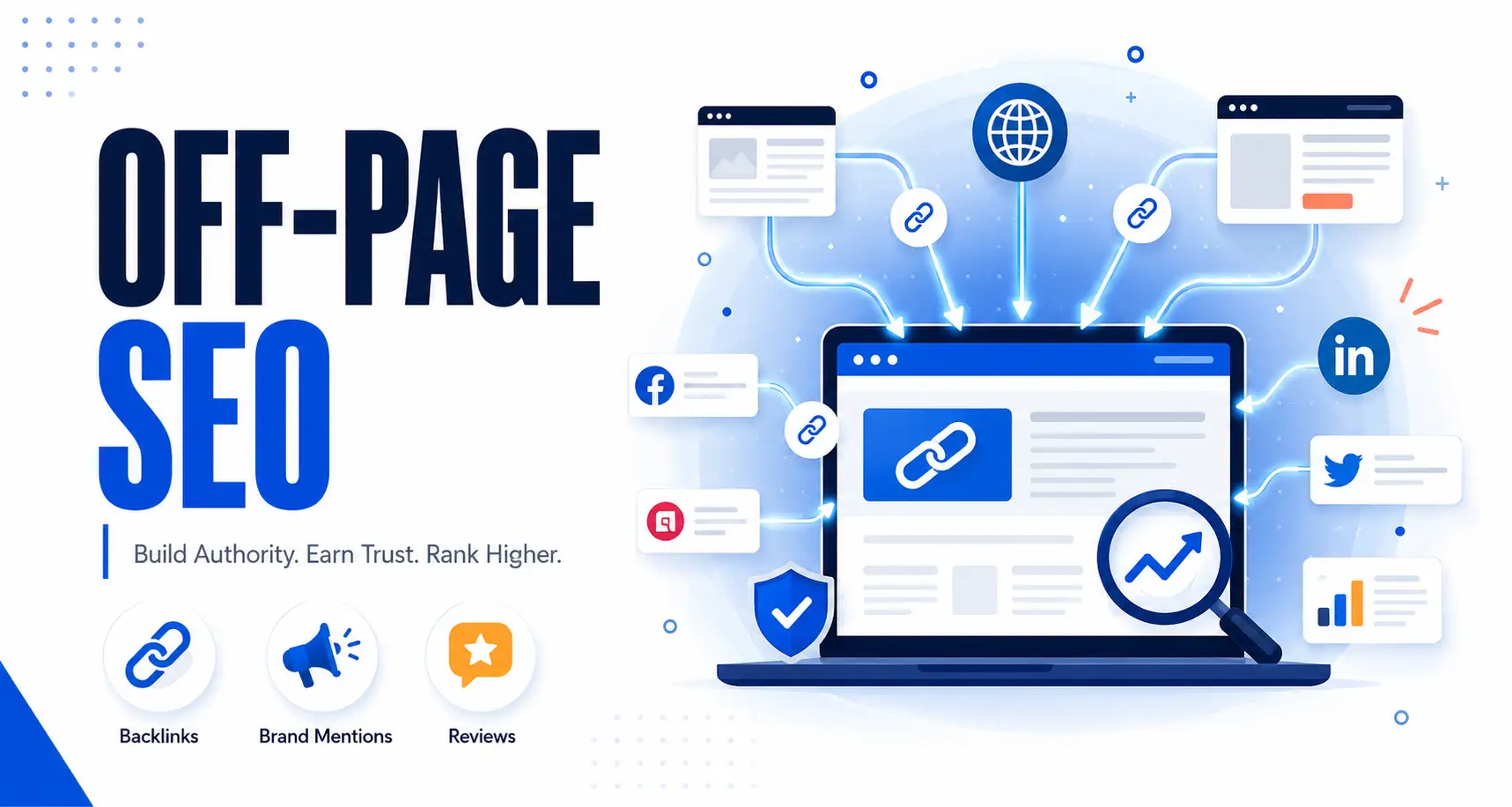
Off-page SEO is every ranking signal you earn from outside your own website — backlinks, brand mentions, social engagement, reviews, and the general “buzz” that tells search engines you’re worth trusting.
Unlike on-page elements, you can’t just edit off-page signals in your CMS and hit publish. You earn them. A journalist links to your data because it’s genuinely useful. A customer leaves a five-star review because they meant it. A niche community shares your guide because it actually solved their problem. None of that happens inside your website’s code — it happens out in the wild, on other people’s platforms, in other people’s words.
That’s exactly why Google weighs it so heavily. On-page signals are self-reported — you’re telling Google what your page is about. Off-page signals are third-party validation — other sites and people are vouching for you. And third-party validation is a lot harder to fake convincingly (though plenty of people still try, more on that later).
A few things typically fall under the off-page umbrella:
- Backlinks from other websites pointing to yours
- Brand mentions, linked or not
- Social signals, shares, engagement, community discussion
- Google Business reviews and reputation across platforms like Google Business Profile or industry-specific directories
- Digital PR and influencer collaborations
- Guest content and expert contributions on other sites
The common thread? Someone else, somewhere else, is doing the talking on your behalf.
Off-Page SEO’s Role Alongside On-Page and Technical SEO
If you’ve read our On-Page SEO guide, you already know the distinction between what you write and how you write it. Off-page SEO adds a third dimension most beginners miss entirely: what does the rest of the internet think of you?
Here’s where Technical SEO fits into the picture, since it’s often left out of the conversation:
None of these three work in isolation. A technically flawless, perfectly optimized page still won’t outrank a competitor with stronger off-page authority — and even the strongest backlink profile can’t save a page Google can’t properly crawl in the first place. They’re not competing priorities. They’re three legs of the same table.
How Off-Page SEO Works
Here’s what actually happens behind the scenes when off-page SEO does its job.
Every time another website links to yours, mentions your brand, or drives traffic your way, search engines treat it as a small vote of confidence. Not a vote for your keywords — a vote for your credibility. Google’s crawlers follow these signals across the web, mapping out a picture of how trusted, relevant, and authoritative your site is compared to everyone else competing for the same query.
This is where E-E-A-T — Experience, Expertise, Authoritativeness, and Trustworthiness — comes into play. Google can’t interview you to check if you’re a real expert. So it looks for proxies: Are authoritative sites in your industry linking to you? Are people searching for your brand name directly? Does your content get cited, shared, or referenced by others who’d know? Off-page signals are essentially Google’s way of crowdsourcing your credibility check.
A few mechanics worth understanding:
- Link equity (or “link juice”) flows between sites. A backlink from a high-authority, topically relevant site passes more trust than ten backlinks from low-quality or unrelated ones.
- Context matters as much as the link itself. A link from a well-regarded industry publication, surrounded by relevant content, carries more weight than the same link buried in a random directory.
- Signals compound over time. Off-page authority isn’t built in a week — search engines tend to trust patterns that develop naturally and consistently, which is part of why manipulative shortcuts get flagged.
- Unlinked mentions still count. Google’s algorithms are increasingly capable of recognizing your brand name even without a clickable link, treating it as a weaker but still real trust signal.
Put simply: on-page SEO tells Google what your page is about. Off-page SEO tells Google whether anyone else believes it.
Also Read: The Complete Guide of International SEO to Ranking in Global Markets
The Most Important Off-Page SEO Ranking Factors
Not every off-page signal carries the same weight — and treating them all as equally important is one of the fastest ways to waste time on tactics that barely move rankings. Search engines run each signal through their own filter of trust, relevance, and authenticity before deciding how much credit to give it.
Some factors, like backlink quality, can single-handedly shift where you land on page one. Others play a quieter, supporting role. Understanding which is which lets you focus your energy where it actually counts. Here’s what matters most, roughly in order of impact.
- Backlink quality and authority
Still the heavyweight champion of off-page ranking factors. A single link from a trusted, topically relevant, high-authority domain can outweigh dozens of weak or spammy ones. What Google weighs here includes the linking site’s own authority, how relevant its content is to yours, and whether the link sits naturally within the content (versus stuffed in a footer or sidebar). - Anchor text diversity
The clickable text used in a backlink gives Google context about what your page is about — but overly optimized, repetitive anchor text (the same exact keyword, over and over) reads as manipulative. A natural link profile mixes branded anchors, generic phrases (“click here,” “this guide”), and keyword-relevant text. - Referring domain diversity
Ten links from ten different websites typically carry more weight than fifty links from the same site. Google reads a wide spread of unique domains as a sign that your authority is broad-based, not manufactured from one or two sources. - Brand mentions and citations
Even without a link, being mentioned by name across credible sources builds a pattern of recognition search engines pick up on — especially when paired with searches for your brand name directly. - Social signals
Shares, comments, and engagement don’t directly boost rankings the way backlinks do, but they amplify content’s reach, which indirectly increases the chance of earning real backlinks and mentions. - Reviews and reputation
Particularly influential for local and service-based businesses. Review volume, recency, and rating consistency across platforms like Google Business Profile factor into how trustworthy your business appears. - Referral traffic quality
When people click through from another site and actually engage with your content (rather than bouncing immediately), it reinforces that the referring link was relevant and valuable — not just placed for SEO’s sake. - Domain and page-level trust metrics
Metrics like Domain Authority (Moz) or Domain Rating (Ahrefs) aren’t official Google ranking factors, but they’re useful proxies for tracking how your off-page profile is trending over time.
The pattern across all of these: Google isn’t just counting signals, it’s evaluating whether they look earned or engineered. That distinction becomes especially important in the next section, where we’ll get into the actual techniques for building these signals the right way.
15 Proven Off-Page SEO Types and Their Techniques
Knowing the ranking factors is one thing — actually building them is another. Below are 15 techniques that consistently move the needle, grouped by category so you can focus on what fits your brand and resources instead of trying to do everything at once.
Link Building Techniques
- Guest posting on relevant, authoritative sites
Contribute genuinely useful content to publications your target audience already reads. The goal isn’t the link alone — it’s getting in front of an audience that trusts the site you’re writing for. - Broken link building
Find dead links on relevant websites, then suggest your own content as a replacement. It’s a win for the site owner (fixed link) and a natural way to earn a placement. - HARO and journalist outreach
Respond to reporters looking for expert sources. A single quote picked up by a major publication can earn a high-authority link plus credibility by association. - Resource page link building
Many sites maintain curated “resource” or “further reading” pages. If your content genuinely fits, a polite pitch can land a relevant, evergreen link.
Brand & Authority Building
- Digital PR campaigns
Create original data, studies, or newsworthy angles that journalists and industry sites want to cover organically — this is link building that doesn’t feel like link building. - Influencer and creator collaborations
Partnering with respected voices in your niche extends your reach to an audience that already trusts them, translating into mentions, shares, and links. - Podcast guesting
Appearing as a guest on niche podcasts builds brand recognition and usually earns a link from the show notes — plus positions you as an expert in your space. - Expert roundups and co-citations
Getting quoted or featured alongside other recognized names in your industry builds association-based authority, even without a direct backlink every time.
Social & Community Signals
- Strategic social media sharing
Consistent, platform-native sharing (not just cross-posting the same link everywhere) increases visibility and the odds of organic pickup by others. - Forum and Q&A participation
Genuinely helpful answers on platforms like Quora or niche forums build brand recognition over time — spammy self-promotion does the opposite. - Niche community engagement
Being an active, valuable member of industry-specific communities (Slack groups, Discord servers, subreddits) builds the kind of organic word-of-mouth that eventually turns into links and mentions. - User-generated content and advocacy
Encouraging customers or users to share their experience — reviews, testimonials, case studies — creates authentic off-page signals you can’t manufacture yourself.
Local & Citation-Based
- Google Business Profile optimization
For local and service-based businesses, an optimized, active, review-rich profile is one of the highest-impact off-page moves available. - Local directory and citation consistency
Ensuring your Name, Address, and Phone number (NAP) are consistent across directories builds local trust signals search engines rely on heavily. - Local partnerships and sponsorships
Sponsoring local events or partnering with complementary local businesses often earns genuine, geographically relevant backlinks and mentions.
Off-Page SEO Strategies That No Longer Work
Not every off-page tactic has aged well. Some techniques that used to work quietly stopped working years ago — and a few can actively get you penalized if you’re still relying on them. Here’s what to leave behind.
- Private Blog Networks (PBNs)
Building or buying a network of sites purely to funnel links to your main site used to fly under the radar. Google’s gotten much better at spotting the footprint — shared hosting, thin content, unnatural linking patterns — and PBN-linked sites regularly get deindexed entirely. - Paid link schemes
Buying links in bulk from marketplaces or link farms violates Google’s guidelines outright. It might produce a short-term bump, but it’s one of the fastest ways to trigger a manual action. - Article directory submissions
Mass-submitting the same article to dozens of low-quality directories was a staple tactic in the early 2010s. These directories carry little to no authority now, and the links they produce are largely ignored — or flagged as spam. - Excessive reciprocal linking
“I’ll link to you if you link to me” schemes, especially when done at scale through link exchange networks, create unnatural patterns Google’s algorithms are specifically trained to detect. - Blog comment spam
Dropping keyword-stuffed links in blog comment sections never carried much weight and is now almost universally nofollowed or moderated out — plus it does more brand damage than good. - Exact-match anchor text stuffing
Forcing the same exact keyword as anchor text across every backlink used to help rankings directly. Now it reads as a manipulation signal and can trigger algorithmic suppression rather than a boost. - Automated link building software
Tools that mass-generate backlinks across forums, profiles, and low-quality sites leave an obvious, easily detectable footprint — the kind of shortcut that costs far more than it saves. - Low-quality guest post networks
Not all guest posting is safe. Networks built purely to sell placements on thin, irrelevant sites (with no real audience or editorial standard) have been repeatedly targeted in Google’s spam updates.
The common thread across all of these: they try to simulate authority instead of earning it. Search engines have spent years closing the gap between what looks earned and what actually is — and that gap keeps getting smaller.
How to Create an Off-Page SEO Strategy
Knowing the techniques is only half the equation. Without a clear strategy tying them together, you end up scattered across a dozen tactics at once — a little guest posting here, a few social shares there — with no real sense of what’s actually moving the needle. A strategy gives your effort direction and lets you measure whether it’s working before you’ve burned months on the wrong approach. Here’s how to build one step by step.
1. Audit Your Current Off-Page Profile
Before you build anything new, you need an honest picture of where you’re starting from. Pull your current backlink profile and look at the total number of referring domains, the authority level of the sites linking to you, and how healthy your anchor text distribution looks. Check your brand mention volume across the web, even the unlinked ones, and review your presence on platforms like Google Business Profile if you’re a local or service-based business.
This audit becomes your baseline. Without it, you have no real way to tell whether your strategy six months from now is actually working, or whether you’re just busy without measurable progress.
2. Study Your Competitors’ Backlink Gaps
Once you know your own starting point, turn your attention outward. Identify two or three competitors who consistently outrank you for your priority keywords, and dig into where their authority is coming from. A link gap (or “content gap”) analysis shows you which domains link to your competitors but not to you — this is often the single fastest way to build a realistic outreach target list, since these sites have already proven they’re willing to link to content in your space.
Pay attention not just to how many links your competitors have, but what kind — are they earning links through PR, guest content, partnerships, or something else? That pattern tells you what’s actually working in your niche right now.
3. Set Specific, Measurable Goals
“Get more backlinks” isn’t a strategy — it’s a vague hope. A real goal has a number and a timeframe attached: grow referring domains by 20% in six months, increase branded search volume by 15% quarter-over-quarter, or reach an average of 4.5 stars across 50+ reviews by year-end.
Specific goals do two things. They force you to choose techniques that actually serve that outcome instead of chasing every tactic at once, and they give you a clear signal for when something isn’t working, so you can adjust before wasting months on a dead-end approach.
4. Choose Techniques That Fit Your Resources and Industry
Not every technique from the previous section suits every business, and trying to run all fifteen at once usually means doing all of them poorly. A local service business — a dentist, a contractor, a salon — will typically get far more return from Google Business Profile optimization, local citations, and community sponsorships than from a national digital PR campaign. A B2B SaaS company, on the other hand, often sees stronger results from guest posts on industry publications, original research, and podcast guesting, where the audience is narrower but far more relevant.
Match the technique to where your actual audience spends time and what your team realistically has the bandwidth to execute consistently — a strategy you can sustain for months beats one that burns out your resources in three weeks.
5. Build a Realistic Outreach Plan
Off-page SEO runs on relationships, not volume. A focused list of 20 genuinely relevant, carefully researched sites will consistently outperform a spray-and-pray list of 200 irrelevant ones, because relevance is exactly what search engines are trying to detect.
Personalize every outreach message — reference the specific article or page you’re pitching against, explain clearly why your content adds value to their audience, and avoid anything that reads like a template blasted to a mailing list. Response rates for genuine, researched outreach are dramatically higher than generic mass pitches, and the relationships you build often lead to repeat placements down the line.
6. Create Link-Worthy Assets
Outreach only works if you actually have something worth linking to. Original research, proprietary data studies, in-depth guides that go deeper than anything else ranking, free tools, or templates all give outreach targets a genuine reason to link — beyond simply doing you a favor.
Without an asset like this, outreach becomes a numbers game with a low success rate, because you’re essentially asking someone to link to you with nothing meaningfully valuable to offer their own readers in return.
7. Track, Adjust, and Stay Consistent
Off-page results compound slowly — expect to see meaningful movement over months, not days. Revisit your core metrics on a monthly basis: referring domain growth, keyword position changes, branded search volume, and review velocity.
Double down on whatever channel is producing real movement, and be willing to drop tactics that show no measurable return after a reasonable testing period (three to six months is usually enough to tell). The strategies that hold up long-term treat off-page SEO as an ongoing relationship-building process, not a campaign you launch once and forget.
Best Tools for Off-Page SEO
Manually tracking backlinks, brand mentions, and competitor movements across the entire web isn’t realistic — the right tools turn what would be weeks of manual digging into a process you can actually run consistently. Here’s a breakdown of what each category does and which tools are worth your attention.
Backlink analysis tools are your starting point for almost everything else in this list — they show you your current link profile, reveal competitor gaps, and flag toxic or spammy links that could be dragging your authority down rather than building it. Digital PR and outreach tools help you manage the relationship side of off-page SEO at scale, since manually tracking follow-ups and responses across dozens of pitches quickly becomes unmanageable without one.
Brand monitoring tools catch the mentions that backlink trackers miss entirely — unlinked citations, social chatter, and forum discussions that still count as trust signals even without a clickable link. And if your business has any local component, local SEO tools are non-negotiable, since citation consistency and review management are difficult to maintain manually once you’re listed across more than a handful of directories.
Most brands don’t need every tool on this list — a solid starting stack is usually one backlink analysis tool, Google Alerts (free) for basic brand monitoring, and a local tool if relevant to your business. You can layer in outreach and social listening tools as your off-page efforts scale.
Also Read: Local SEO Guide and Why the Businesses Down the Street Are Beating You on Google
How to Measure Off-Page SEO Success
Building backlinks and earning mentions means little if you can’t tell whether they’re actually translating into rankings, traffic, or business results. Measurement is what separates a strategy from a guessing game — here’s what to actually track and why each metric matters.
- Referring domain growth
Track the number of unique domains linking to you over time, not just total backlinks. A steady increase in unique referring domains signals genuinely expanding authority, while a spike in backlinks from the same few domains usually signals something less organic. - Domain Authority / Domain Rating movement
While neither Moz’s Domain Authority nor Ahrefs’ Domain Rating is an official Google ranking factor, both are useful directional indicators. Watching this score trend upward over months tells you your off-page profile is strengthening relative to competitors in your space. - Organic keyword rankings
The end goal of off-page SEO is ultimately better rankings. Track how your target keywords move over time, and pay particular attention to rankings for pages that recently earned new backlinks or mentions — a jump shortly after a placement is a strong signal that link worked. - Branded search volume
When more people search for your brand name directly, it’s a strong sign your off-page visibility efforts — PR, mentions, influencer collaborations — are building real-world recognition, not just search engine signals. - Referral traffic and engagement
Check Google Analytics for traffic coming directly from the sites that link to you. Look beyond just the click — engagement metrics like time on page and bounce rate tell you whether that referral traffic is genuinely interested, which reinforces to search engines that the link was relevant. - Share of voice
Compare how often your brand is mentioned or ranks for relevant topics versus your competitors. A growing share of voice within your niche indicates your off-page efforts are outpacing the competition, not just growing in isolation. - Review volume and rating trends
For local and service-based businesses, track review count, average rating, and response rate over time across platforms like Google Business Profile. Consistent, recent, positive reviews are one of the clearest off-page trust signals search engines and customers both respond to.
The mistake most people make is tracking backlink count alone and calling it a day. A single metric never tells the full story — it’s the combination of authority movement, ranking changes, and real-world brand recognition together that shows whether your off-page strategy is actually working.
Common Off-Page SEO Mistakes
Even well-intentioned off-page efforts can backfire when a few common missteps creep in — and unlike on-page errors, which are usually easy to spot and fix, off-page mistakes often take months to reveal themselves, since backlink profiles and brand authority build up slowly over time.
By the time the damage shows up as a ranking drop or a manual action, the mistake has usually been compounding quietly for a while. Catching these patterns early saves you from having to undo months of misdirected effort. Here’s what to watch out for.
- Chasing link quantity over quality
Racking up dozens of low-authority, irrelevant backlinks feels productive, but it rarely moves rankings — and in some cases actively drags down your link profile’s overall trust. One relevant, high-authority link consistently outperforms ten weak ones. - Ignoring relevance in favor of authority alone
A backlink from a high-authority site that has nothing to do with your industry carries far less weight than a link from a smaller, but topically relevant, site. Chasing authority scores without considering context misses what search engines are actually evaluating. - Over-optimizing anchor text
Using the exact same keyword-rich anchor text across most of your backlinks looks manufactured rather than natural, and can trigger algorithmic scrutiny instead of a ranking boost. A natural link profile mixes branded, generic, and keyword anchors. - Neglecting brand mentions without links
Some brands only track linked backlinks and ignore unlinked mentions entirely. Since search engines increasingly recognize brand mentions as a trust signal on their own, this means missing a real opportunity — and missing chances to reach out and turn those mentions into links. - Treating off-page SEO as a one-time project
Running a single outreach campaign and stopping once a few links land is a common trap. Off-page authority compounds through consistency; sporadic bursts of activity followed by long silence rarely build the kind of sustained trust search engines reward. - Ignoring local signals for local businesses
Local and service-based businesses that skip Google Business Profile optimization, citation consistency, and review management are leaving one of the highest-impact off-page channels almost entirely untouched. - Falling back on outdated or risky tactics
Reverting to PBNs, paid link schemes, or automated link building software out of impatience for faster results is one of the fastest ways to trigger a manual action — undoing months or years of legitimate off-page work in the process. - Not tracking the right metrics
Focusing solely on backlink count while ignoring referring domain diversity, branded search growth, and referral traffic quality gives an incomplete — and sometimes misleading — picture of whether your strategy is actually working.
Most of these mistakes share a common root: optimizing for the appearance of authority rather than building it genuinely. Search engines have gotten remarkably good at telling the two apart, and the gap between shortcuts and real results keeps narrowing every year.
Future Trends in Off-Page SEO
Off-page SEO is shifting in ways that reward genuine authority even more than it already does, and understanding where things are headed now will save you from investing in tactics that are quietly losing relevance.
AI-driven search experiences, including Google’s AI Overviews and other generative search features, are increasingly pulling from sources that already carry strong off-page trust signals — meaning brands with established backlink profiles, consistent mentions, and real-world recognition are the ones most likely to get cited or summarized by AI systems, while thinner off-page profiles risk becoming invisible in these new formats entirely.
Alongside this, E-E-A-T weighting is only going to increase, not decrease. As search engines get better at separating genuine expertise from content that merely looks authoritative, off-page signals that demonstrate real-world credibility — expert quotes, journalist citations, industry recognition, authentic reviews — will carry more weight relative to raw backlink counts.
This shift ties directly into the rising importance of unlinked brand mentions as a legitimate ranking signal. Search engines have gotten significantly better at recognizing when your brand is being discussed, even without a clickable link back to your site, which means digital PR and brand-building activities are becoming just as valuable as traditional link building, sometimes more so.
It’s part of a broader move toward digital PR overtaking classic link building as the more sustainable long-term strategy, largely because it produces authority that’s harder to replicate artificially. A backlink you paid for can be discounted by an algorithm update overnight; a reputation built through genuine media coverage and real audience trust is far more resistant to that kind of volatility.
Alongside all of this, zero-click search behavior is reshaping what “success” even means in off-page SEO. With more searches ending without a click, branded search volume, share of voice, and direct traffic are becoming just as important as traditional referral metrics, since they capture visibility that never shows up as a clicked link at all.
Taken together, these shifts point in one clear direction: off-page SEO is moving away from signals you can manufacture and toward signals you can only earn by genuinely building a trusted, recognizable brand — which means the strategies covered throughout this guide will only become more relevant, not less, as search continues to evolve.
Build Real Off-Page Authority with Tsabit Insight
Off-page SEO isn’t something you set up once and walk away from — it’s an ongoing process of earning trust, one relationship, mention, and link at a time, that needs revisiting as your industry shifts and your brand grows. If you’ve made it this far through the guide, you already know there’s a lot of moving pieces to manage well. The good news is, you don’t have to manage all of it alone.
At Tsabit Insight, I provide freelance SEO services built around exactly this kind of process — identifying the right off-page opportunities, building genuine outreach relationships, and turning authority-building into measurable ranking and traffic growth. Every project starts with understanding your goals, your industry, and your competitive landscape, the same way this guide does, before any outreach or tool gets involved.
Whether you’re starting your off-page strategy from scratch or trying to recover from tactics that no longer work, the approach stays grounded in what genuinely earns trust with both search engines and real people — not just what looks good in a backlink report. If you’re looking for a reliable freelance SEO specialist to guide your off-page strategy in the right direction, contact me to discuss your project and discover how Tsabit Insight can help your business grow through stronger, more authentic search visibility.
FAQ