Off-Page SEO: The Complete Guide to Ranking Beyond Your Website
Off-Page SEO is often the reason two websites that look almost identical can rank very differently for the same keyword — even if one has less impressive on-page content. You might have perfectly optimised title tags, well-placed keywords, and a site structure that would make any SEO specialist smile, yet still find yourself outranked by a competitor with stronger authority and credibility.
Here’s where many people new to SEO get it wrong: they assume SEO is all about what happens on their own website. Optimise your pages, publish quality content, tick all the technical boxes, and you’re done. But Google doesn’t just pay attention to what you say about your business — it also considers what the rest of the web says about you. Are trusted websites linking to your content? Are people mentioning your brand online? Does your business have the kind of reputation others would confidently recommend?
That’s essentially what Off-Page SEO is all about — the activities that happen beyond your own website to build trust, authority, and credibility in the eyes of both search engines and potential customers.
A simple way to think about it is this: if On-Page SEO is turning up to a job interview looking professional, Off-Page SEO is having a solid reputation that gets people speaking highly of you before you even walk through the door.
What Is Off-Page SEO?
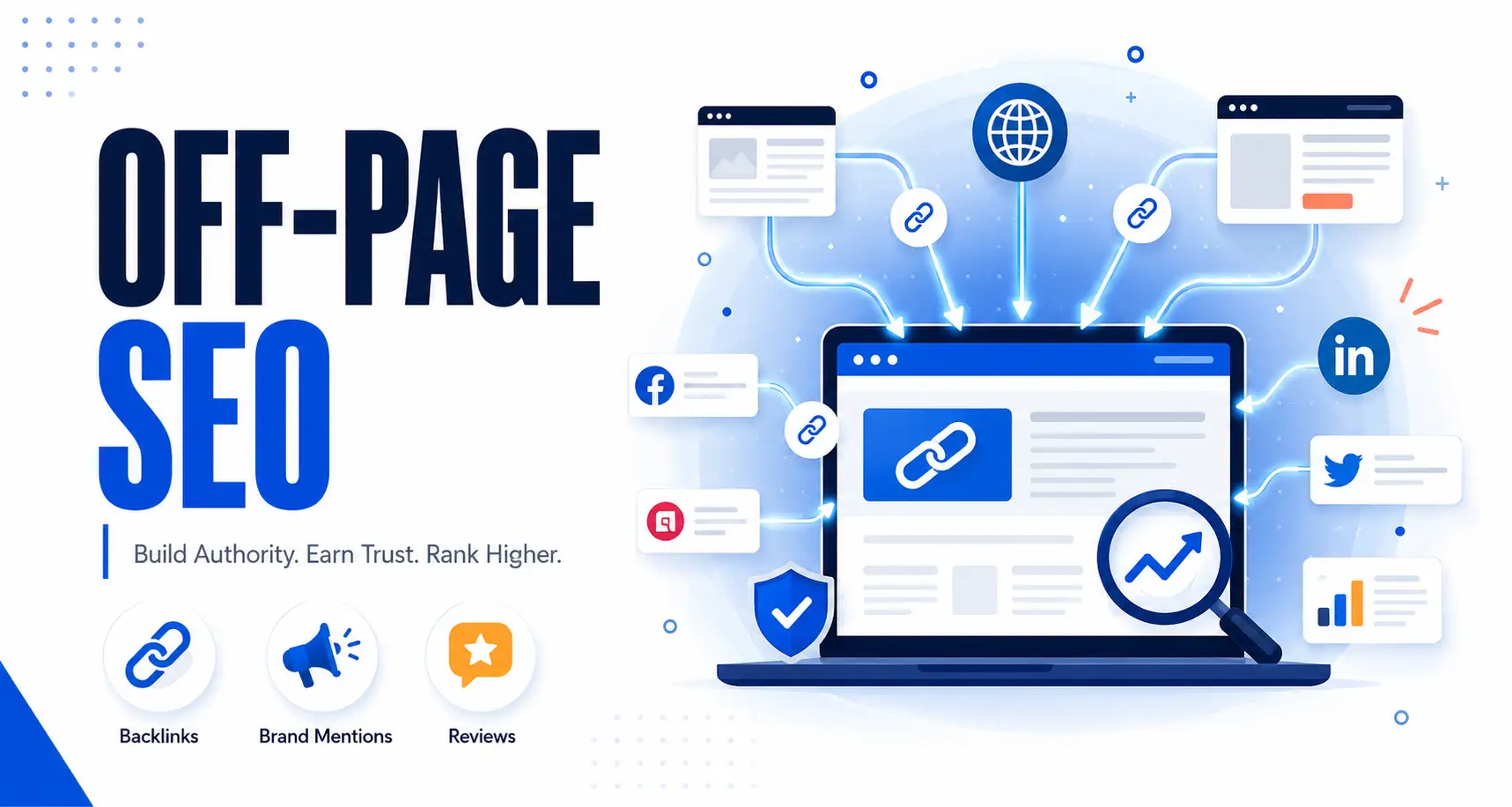
Off-Page SEO refers to all the ranking signals your website earns from outside your own site — including backlinks, brand mentions, social engagement, online reviews, and the overall buzz that tells search engines your business is trustworthy and credible.
Unlike on-page SEO, you can’t simply log into your CMS, make a few changes, and hit publish. Off-page signals have to be earned. A journalist links to your research because it’s genuinely valuable. A customer leaves a five-star review because they had a great experience. Someone in your industry shares your guide because it helped solve a real problem. None of those things happen within your website itself — they happen across the wider web, on other people’s websites and platforms.
That’s one of the reasons Google places so much value on off-page SEO. On-page signals are self-published — you’re telling Google what your content is about. Off-page signals, on the other hand, act as independent endorsements. They’re evidence that other websites, businesses, and people trust your content enough to reference, recommend, or discuss it. While these signals can be manipulated, earning genuine recognition is far more difficult than simply editing your own website.
Common elements of Off-Page SEO include:
- Backlinks from reputable websites pointing to your pages
- Brand mentions, whether they’re linked or unlinked
- Social signals, such as shares, comments, and community discussions
- Google Business reviews, customer reviews and online reputation across platforms like Google Business Profile and industry-specific directories
- Digital PR campaigns and collaborations with industry influencers
- Guest articles and expert contributions published on other websites
The common thread is straightforward: someone else is talking about your business, your content, or your expertise. The more credible those endorsements are, the stronger the trust signals they send to both search engines and potential customers.
Off-Page SEO’s Role Alongside On-Page and Technical SEO
If you’ve read our On-Page SEO guide, you already know the difference between what you write and how you write it. Off-Page SEO adds a third dimension that many beginners overlook: what does the rest of the internet think of you?
This is where Technical SEO fits into the picture, as it’s often left out of the conversation:
None of these three work in isolation. A technically flawless, perfectly optimised page still won’t outrank a competitor with stronger off-page authority — and even the strongest backlink profile can’t save a page that Google can’t properly crawl in the first place. They’re not competing priorities. They’re three legs of the same stool.
How Off-Page SEO Works
Here’s what actually happens behind the scenes when Off-Page SEO does its job.
Every time another website links to yours, mentions your brand, or sends traffic your way, search engines treat it as a small vote of confidence. Not a vote for your keywords — a vote for your credibility. Google’s crawlers follow these signals across the web, building a picture of how trusted, relevant, and authoritative your website is compared with everyone else competing for the same search query.
This is where E-E-A-T — Experience, Expertise, Authoritativeness, and Trustworthiness — comes into play. Google can’t interview you to find out whether you’re a genuine expert, so it looks for other indicators. Are authoritative websites in your industry linking to you? Are people searching for your brand by name? Is your content being cited, shared, or referenced by others who know the subject? Off-page signals are essentially Google’s way of gathering independent evidence of your credibility.
A few mechanics are worth understanding:
- Link equity (or “link juice”) flows between websites. A backlink from a high-authority, topically relevant website passes more trust than ten backlinks from low-quality or unrelated websites.
- Context matters just as much as the link itself. A backlink from a respected industry publication, surrounded by relevant content, carries more weight than the same link buried in a random directory.
- Signals build over time. Off-page authority isn’t built in a week. Search engines tend to trust patterns that develop naturally and consistently, which is one reason manipulative shortcuts are often identified.
- Unlinked brand mentions still matter. Google’s algorithms are becoming increasingly capable of recognising your brand name even without a clickable link, treating it as a weaker—but still meaningful—trust signal.
Put simply, On-Page SEO tells Google what your page is about. Off-Page SEO tells Google whether anyone else believes it.
Also Read:The Complete Guide of International SEO to Ranking in Global Markets
The Most Important Off-Page SEO Ranking Factors
Not every off-page signal carries the same weight, and treating them all as equally important is one of the quickest ways to waste time on tactics that barely improve your rankings. Search engines evaluate each signal based on trust, relevance, and authenticity before deciding how much value to assign it.
Some factors, such as backlink quality, can significantly influence where your page ranks. Others play a quieter, supporting role. Understanding the difference helps you focus your efforts where they’ll have the greatest impact. Here’s what matters most, roughly in order of importance.
Backlink Quality and Authority
Still the heavyweight champion of off-page ranking factors. A single backlink from a trusted, topically relevant, high-authority website can outweigh dozens of weak or spammy links. Google considers factors such as the linking website’s authority, how relevant its content is to yours, and whether the link appears naturally within the content rather than being placed in a footer or sidebar.
Anchor Text Diversity
The clickable text used in a backlink gives Google context about what your page is about. However, overly optimised, repetitive anchor text (using the same keyword repeatedly) can appear manipulative. A natural backlink profile includes a healthy mix of branded anchors, generic phrases (such as “click here” or “this guide”), and keyword-relevant anchor text.
Referring Domain Diversity
Ten backlinks from ten different websites generally carry more weight than fifty backlinks from the same website. Google sees links from a broad range of unique domains as a sign that your authority has been earned across the web rather than created from just one or two sources.
Brand Mentions and Citations
Even without a backlink, mentions of your brand across credible websites help build recognition that search engines can identify—especially when they’re supported by people searching directly for your brand.
Social Signals
Shares, comments, and engagement don’t directly improve rankings in the same way backlinks do, but they increase your content’s visibility. That wider reach can lead to more genuine backlinks, brand mentions, and other valuable off-page signals.
Reviews and Reputation
This is particularly important for local businesses and service providers. The number of reviews, how recent they are, and the consistency of your ratings across platforms such as Google Business Profile all contribute to how trustworthy your business appears.
Referral Traffic Quality
When people click through from another website and genuinely engage with your content instead of leaving straight away, it reinforces that the referring link is relevant and valuable—not simply placed for SEO purposes.
Domain and Page-Level Trust Metrics
Metrics such as Domain Authority (Moz) and Domain Rating (Ahrefs) aren’t official Google ranking factors, but they’re useful benchmarks for measuring how your off-page authority is developing over time.
The pattern across all of these is straightforward: Google isn’t just counting signals—it evaluates whether they appear to be earned or artificially created. That distinction becomes even more important in the next section, where we’ll look at the techniques for building these signals the right way.
15 Proven Off-Page SEO Types and Their Techniques
Knowing the ranking factors is one thing—actually building them is another. Below are 15 techniques that consistently move the needle, grouped by category so you can focus on the approaches that best suit your brand and resources, rather than trying to do everything at once.
Link Building Techniques
- Guest Posting on Relevant, Authoritative Websites
Contribute genuinely useful content to publications your target audience already reads. The goal isn’t just to earn a backlink—it’s to reach an audience that already trusts the website you’re contributing to. - Broken Link Building
Find broken links on relevant websites, then suggest your own content as a replacement. It’s a win-win: the website owner fixes a broken link, and you earn a relevant backlink naturally. - HARO and Journalist Outreach
Respond to journalists looking for expert sources. A single quote featured in a major publication can earn you a high-authority backlink, while also strengthening your credibility through association. - Resource Page Link Building
Many websites maintain curated resource pages or “further reading” sections. If your content genuinely adds value, a well-targeted outreach email can earn you a relevant, long-lasting backlink.
Brand & Authority Building
- Digital PR Campaigns
Create original research, unique data, or newsworthy stories that journalists and industry publications want to cover naturally. It’s link building that doesn’t feel like traditional link building. - Influencer and Creator Collaborations
Working with respected voices in your industry helps you reach audiences that already trust them, often resulting in valuable brand mentions, shares, and backlinks. - Podcast Guest Appearances
Appearing as a guest on industry podcasts increases brand awareness and usually earns a backlink from the episode’s show notes, while also positioning you as an authority in your field. - Expert Roundups and Co-Citations
Being quoted or featured alongside recognised experts in your industry strengthens your authority through association, even when every mention doesn’t include a backlink.
Social & Community Signals
- Strategic Social Media Sharing
Share your content consistently using approaches that suit each platform, rather than posting the exact same message everywhere. This improves visibility and increases the chances of your content being picked up organically. - Forum and Q&A Participation
Providing genuinely helpful answers on platforms such as Quora or niche community forums builds brand recognition over time. Constant self-promotion, on the other hand, usually has the opposite effect. - Niche Community Engagement
Actively contributing to industry communities—whether they’re Slack groups, Discord servers, Reddit communities, or professional forums—helps build genuine relationships that often lead to natural mentions and backlinks. - User-Generated Content and Advocacy
Encouraging customers to share reviews, testimonials, or case studies creates authentic off-page signals that are difficult to replicate artificially.
Local & Citation-Based SEO
- Google Business Profile Optimisation
For local businesses and service providers, maintaining a well-optimised, active Google Business Profile with consistent customer reviews is one of the most effective off-page SEO strategies available. - Local Directory and Citation Consistency
Making sure your business name, address, and phone number (NAP) are consistent across online directories helps build the local trust signals that search engines rely on. - Local Partnerships and Sponsorships
Supporting local events or partnering with complementary businesses in your area often leads to genuine, locally relevant backlinks and brand mentions.
Off-Page SEO Strategies That No Longer Work
Not every off-page tactic has stood the test of time. Some techniques that once delivered results quietly stopped working years ago, while others can now do more harm than good if you’re still relying on them. Here’s what to leave behind.
- Private Blog Networks (PBNs)
Building or buying a network of websites purely to funnel backlinks to your main website once flew under the radar. Google has become much better at identifying the footprint—shared hosting, thin content, and unnatural linking patterns—and websites connected to PBNs are regularly deindexed altogether. - Paid Link Schemes
Buying backlinks in bulk from marketplaces or link farms is a direct violation of Google’s guidelines. It might produce a short-term improvement, but it’s also one of the quickest ways to attract a manual action. - Article Directory Submissions
Submitting the same article to dozens of low-quality directories was a common tactic in the early 2010s. Today, these directories carry little to no authority, and the backlinks they generate are largely ignored—or even treated as spam. - Excessive Reciprocal Linking
“I’ll link to you if you link to me” arrangements, particularly when carried out at scale through link exchange networks, create unnatural linking patterns that Google’s algorithms are specifically designed to detect. - Blog Comment Spam
Dropping keyword-stuffed backlinks into blog comment sections has never carried much value. Today, most of these links are either marked as nofollow or removed through moderation, and they can damage your brand’s reputation more than they help your SEO. - Exact-Match Anchor Text Stuffing
Using the same exact keyword as anchor text across every backlink once helped improve rankings. Today, it appears manipulative and is more likely to trigger algorithmic suppression than deliver any SEO benefit. - Automated Link Building Software
Tools that automatically generate backlinks across forums, user profiles, and low-quality websites leave an obvious footprint that’s easy for search engines to detect. In most cases, the risks far outweigh any short-term gains. - Low-Quality Guest Post Networks
Not all guest posting is beneficial. Networks built solely to sell guest post placements on thin, irrelevant websites—with little genuine audience or editorial oversight—have been repeatedly targeted by Google’s spam updates.
The common thread across all of these tactics is simple: they try to imitate authority instead of earning it. Search engines have spent years getting better at distinguishing between signals that look natural and those that genuinely are—and that gap continues to narrow.
How to Create an Off-Page SEO Strategy
Knowing the techniques is only half the equation. Without a clear strategy to tie them together, you’ll end up spreading your efforts across a dozen different tactics—a bit of guest posting here, a few social shares there—without any real understanding of what’s actually improving your rankings. A well-defined strategy gives your efforts direction and helps you measure what’s working before you’ve spent months on the wrong approach. Here’s how to build one step by step.
1. Audit Your Current Off-Page Profile
Before you build anything new, you need an honest picture of where you’re starting. Review your current backlink profile and assess the number of referring domains, the authority of the websites linking to you, and whether your anchor text profile looks natural and balanced. Check how often your brand is mentioned across the web—even when those mentions don’t include a backlink—and review your presence on platforms such as Google Business Profile if you’re a local or service-based business.
This audit becomes your baseline. Without it, there’s no reliable way to measure whether your strategy is delivering results six months from now or whether you’re simply staying busy without making meaningful progress.
2. Study Your Competitors’ Backlink Gaps
Once you understand your own position, look at your competitors. Identify two or three businesses that consistently outrank you for your target keywords, then investigate where their authority comes from. A backlink gap (or content gap) analysis reveals which websites link to your competitors but not to you. This is often one of the quickest ways to build a practical outreach list because those websites have already shown they’re willing to link to content within your industry.
Don’t just focus on the number of backlinks your competitors have. Look at how they earned them. Are they gaining links through digital PR, guest posts, partnerships, original research, or something else? Those patterns often reveal what’s working in your niche right now.
3. Set Specific, Measurable Goals
“Get more backlinks” isn’t a strategy—it’s a vague objective. A meaningful goal includes both a measurable target and a timeframe. For example, increase referring domains by 20% over six months, grow branded search volume by 15% quarter-on-quarter, or achieve an average Google review rating of 4.5 stars across more than 50 reviews by the end of the year.
Clear goals help you prioritise the techniques that support your objectives instead of chasing every opportunity. They also make it easier to recognise when something isn’t working, allowing you to adjust your approach before investing months in ineffective tactics.
4. Choose Techniques That Suit Your Resources and Industry
Not every technique from the previous section will suit every business, and trying to implement all fifteen at once usually means doing none of them particularly well. A local service business—such as a dentist, builder, or hair salon—will often achieve better results through Google Business Profile optimisation, local citations, and community sponsorships than through a national digital PR campaign. A B2B SaaS company, by comparison, may see greater success from guest posts on industry publications, original research, and podcast appearances, where the audience is smaller but far more relevant.
Choose the techniques that match where your audience spends time and what your team can realistically execute consistently. A strategy you can maintain for months will always outperform one that exhausts your resources within a few weeks.
5. Build a Realistic Outreach Plan
Off-Page SEO is built on relationships, not volume. A carefully researched list of 20 highly relevant websites will almost always outperform a generic list of 200, because relevance is exactly what search engines value.
Personalise every outreach email. Reference the specific article or page you’re contacting them about, explain why your content adds value to their audience, and avoid messages that read like mass-produced templates. Well-researched outreach consistently achieves better response rates, and the relationships you build can often lead to future collaboration opportunities.
6. Create Link-Worthy Assets
Outreach only works when you have something genuinely worth linking to. Original research, proprietary data, comprehensive guides, free tools, templates, and practical resources all give website owners a compelling reason to reference your content.
Without valuable assets, outreach becomes a numbers game with limited success because you’re asking someone to link to your website without offering meaningful value to their audience in return.
7. Track, Adjust, and Stay Consistent
Off-Page SEO takes time to produce meaningful results, so expect progress over months rather than days. Review your key performance metrics each month, including referring domain growth, keyword ranking improvements, branded search volume, and the rate at which you’re earning customer reviews.
Double down on the channels that are producing measurable results, and don’t be afraid to stop investing in tactics that show little or no return after a reasonable testing period—typically three to six months. The most successful off-page strategies treat SEO as an ongoing process of building trust and relationships, not a one-off campaign that’s launched and forgotten.
Best Tools for Off-Page SEO
Manually tracking backlinks, brand mentions, and competitor activity across the web simply isn’t practical. The right tools turn what would otherwise take weeks of manual research into a process you can manage consistently. Here’s an overview of what each category does and which tools are worth considering.
Backlink analysis tools are the foundation of almost every off-page SEO strategy. They help you review your existing backlink profile, identify gaps between your website and your competitors, and uncover toxic or spammy backlinks that may be harming your authority instead of strengthening it. Digital PR and outreach tools, meanwhile, help you manage the relationship-building side of off-page SEO at scale, as manually tracking outreach emails, follow-ups, and responses quickly becomes difficult once you’re contacting multiple websites.
Brand monitoring tools identify mentions that traditional backlink trackers often miss, including unlinked brand citations, social media conversations, and discussions in online communities. While these mentions don’t always include a backlink, they can still contribute to your overall brand authority and trust signals. If your business also targets local customers, local SEO tools are essential for maintaining accurate business citations, monitoring reviews, and keeping your business information consistent across multiple online directories.
Most businesses don’t need every tool available. For many, a practical starting toolkit includes one reliable backlink analysis tool, Google Alerts (which is free) for basic brand monitoring, and a local SEO tool if local search is important to your business. As your Off-Page SEO strategy grows, you can gradually add outreach platforms and social listening tools to support your expanding efforts.
How to Measure Off-Page SEO Success
Building backlinks and earning brand mentions means very little if you can’t tell whether they’re actually leading to better rankings, more traffic, or meaningful business outcomes. Measurement is what separates a strategy from guesswork. Here’s what you should track and why each metric matters.
- Referring Domain Growth
Track the number of unique domains linking to your website over time, rather than simply counting the total number of backlinks. A steady increase in referring domains suggests your authority is growing naturally, whereas a sudden spike in backlinks from the same handful of websites may indicate something less organic. - Domain Authority / Domain Rating Movement
Although Moz’s Domain Authority and Ahrefs’ Domain Rating aren’t official Google ranking factors, they’re still useful benchmarking metrics. Watching these scores improve over time provides a good indication that your off-page authority is strengthening relative to your competitors. - Organic Keyword Rankings
The ultimate goal of Off-Page SEO is to improve your search rankings. Monitor how your target keywords perform over time, paying particular attention to pages that have recently earned new backlinks or brand mentions. If rankings improve shortly after those placements, it’s a strong indication that your off-page efforts are having an impact. - Branded Search Volume
When more people search directly for your brand name, it’s a strong sign that your off-page activities—such as digital PR, brand mentions, and influencer collaborations—are increasing awareness beyond search engines alone. - Referral Traffic and Engagement
Use Google Analytics to monitor traffic arriving from websites that link to you. Don’t just measure clicks. Review engagement metrics such as average engagement time, pages viewed, and bounce rate to understand whether visitors are genuinely interested in your content. Strong engagement reinforces that the referring backlink is relevant and valuable. - Share of Voice
Compare how frequently your brand appears in search results or is mentioned online relative to your competitors. An increasing share of voice within your industry indicates that your off-page efforts are helping you gain visibility faster than others in your market. - Review Volume and Rating Trends
For local businesses and service providers, monitor your total number of reviews, average rating, and response rate across platforms such as Google Business Profile. Consistent, recent, positive reviews remain one of the strongest off-page trust signals for both search engines and potential customers.
The mistake many businesses make is focusing solely on the number of backlinks they’ve acquired. Backlink count alone never tells the full story. It’s the combination of stronger authority, improved rankings, increased brand recognition, and meaningful business results that shows whether your Off-Page SEO strategy is genuinely working.
Common Off-Page SEO Mistakes
Even well-intentioned off-page SEO efforts can backfire when a few common mistakes creep in. Unlike on-page issues, which are usually straightforward to identify and fix, off-page mistakes often take months to become apparent because backlink profiles and brand authority develop gradually over time.
By the time the impact appears as a drop in rankings or a manual action, the problem has often been building in the background for quite some time. Identifying these patterns early can save you from spending months undoing avoidable mistakes. Here’s what to look out for.
- Chasing Link Quantity Over Quality
Building dozens of low-authority, irrelevant backlinks may feel productive, but it rarely improves rankings—and in some cases, it can reduce the overall trustworthiness of your backlink profile. One relevant backlink from a trusted, authoritative website will consistently deliver more value than ten weak ones. - Ignoring Relevance in Favour of Authority Alone
A backlink from a high-authority website that’s completely unrelated to your industry usually carries far less value than one from a smaller but highly relevant website. Focusing only on authority metrics while ignoring topical relevance overlooks what search engines actually assess. - Over-Optimising Anchor Text
Using the same keyword-rich anchor text across most of your backlinks appears unnatural and can attract algorithmic scrutiny instead of improving rankings. A healthy backlink profile includes a balanced mix of branded, generic, and keyword-focused anchor text. - Neglecting Brand Mentions Without Links
Many businesses only monitor backlinks and overlook unlinked brand mentions altogether. As search engines become better at recognising brand mentions as trust signals, ignoring them means missing valuable opportunities—including the chance to turn those mentions into backlinks through outreach. - Treating Off-Page SEO as a One-Off Project
Running a single outreach campaign and stopping after securing a few backlinks is a common mistake. Off-page authority grows through consistent effort, and occasional bursts of activity followed by long periods of inactivity rarely build the lasting trust that search engines reward. - Ignoring Local Signals for Local Businesses
Local businesses and service providers that overlook Google Business Profile optimisation, citation consistency, and review management are missing one of the most influential off-page SEO opportunities available. - Falling Back on Outdated or Risky Tactics
Turning to Private Blog Networks (PBNs), paid link schemes, or automated link-building software because you want faster results is one of the quickest ways to trigger a manual action. In the process, you risk undoing months—or even years—of legitimate off-page SEO work. - Not Tracking the Right Metrics
Focusing only on backlink numbers while ignoring referring domain diversity, branded search growth, and referral traffic quality provides an incomplete—and sometimes misleading—picture of whether your strategy is actually delivering results.
Most of these mistakes have one thing in common: they’re focused on creating the appearance of authority rather than earning it genuinely. Search engines have become remarkably effective at telling the difference, and the gap between shortcuts and sustainable results continues to shrink every year.
Future Trends in Off-Page SEO
Off-Page SEO is evolving in ways that place an even greater emphasis on genuine authority than ever before. Understanding where search is heading today will help you avoid investing in tactics that are gradually becoming less effective.
AI-driven search experiences, including Google’s AI Overviews and other generative search features, are increasingly drawing information from sources with strong off-page trust signals. This means brands with established backlink profiles, consistent brand mentions, and genuine real-world recognition are far more likely to be cited or summarised by AI systems. Businesses with weaker off-page authority, on the other hand, risk becoming far less visible in these emerging search experiences.
At the same time, the importance of E-E-A-T (Experience, Expertise, Authoritativeness, and Trustworthiness) is only expected to grow. As search engines become better at distinguishing genuine expertise from content that merely appears authoritative, off-page signals demonstrating real-world credibility—such as expert quotes, media coverage, industry recognition, and authentic customer reviews—will carry more influence than simply accumulating large numbers of backlinks.
This trend also highlights the growing importance of unlinked brand mentions as a legitimate ranking signal. Search engines have become much better at recognising when your brand is being discussed online, even without a clickable backlink. As a result, digital PR, brand-building campaigns, and thought leadership are becoming just as valuable as traditional link-building efforts, and in some cases, even more valuable.
It’s all part of a broader shift towards digital PR becoming a more sustainable long-term strategy than traditional link building alone. A backlink acquired through payment or manipulation can lose its value overnight after an algorithm update. By contrast, a reputation built through credible media coverage, industry recognition, and genuine audience trust is significantly more resilient to changes in search algorithms.
Another important development is the growth of zero-click search. As more searches are answered directly within search results, success in Off-Page SEO is no longer measured solely by referral traffic. Metrics such as branded search volume, share of voice, and direct website traffic are becoming increasingly important because they reflect brand visibility that doesn’t necessarily result in a click.
Taken together, these trends point in one clear direction: Off-Page SEO is moving away from signals that can be manufactured and towards signals that must be earned through genuine trust, authority, and brand recognition. Businesses that invest in building a credible, recognisable brand—not just acquiring backlinks—will be far better positioned as search continues to evolve.
Build Real Off-Page Authority with Tsabit Insight
Off-page SEO isn’t something you set up once and walk away from — it’s an ongoing process of earning trust, one relationship, mention, and link at a time, that needs revisiting as your industry shifts and your brand grows. If you’ve made it this far through the guide, you already know there’s a lot of moving pieces to manage well. The good news is, you don’t have to manage all of it alone.
At Tsabit Insight, I provide freelance SEO services built around exactly this kind of process — identifying the right off-page opportunities, building genuine outreach relationships, and turning authority-building into measurable ranking and traffic growth. Every project starts with understanding your goals, your industry, and your competitive landscape, the same way this guide does, before any outreach or tool gets involved.
Whether you’re starting your off-page strategy from scratch or trying to recover from tactics that no longer work, the approach stays grounded in what genuinely earns trust with both search engines and real people — not just what looks good in a backlink report. If you’re looking for a reliable freelance SEO specialist to guide your off-page strategy in the right direction, get in touch to discuss your project and discover how Tsabit Insight can help your business grow through stronger, more authentic search visibility.
FAQ